
What Is an AI App Builder? How They Work and What Six Runs Produced
An AI app builder turns a plain-language description into a working application: interface, logic, database, sign-in and hosting, published to a URL, with no code written by you. The pages ranking for the term are the vendors' own, each promising minutes and showing no build you can inspect. This page explains the category from the outside and adds what those pages do not have: six measured runs on one builder, with the credits, the questions the model asked first, and what came back.
Updated
What is an AI app builder?
A platform that writes and runs an application from a description. You type what the app is for and who uses it; the builder generates the pages and the logic, creates a database and a sign-in system, hosts the result and gives you a URL. The vendors agree on the shape. Base44 defines it as “An AI app builder is a platform that lets you create fully functional apps using plain language, no coding required.”; Replit calls itself “Replit is a free AI app builder that turns natural language prompts into [...] working software, without writing a line of code.”; and Lovable's documentation describes “Lovable is a full-stack AI development platform for building, iterating on, and deploying web applications using natural language”, all read on 27 September 2026.
Two things separate the category from what came before it. Against no-code, the builder writes code rather than assembling blocks, so the output is a codebase you can export, and so the app can do anything code does, including things you did not ask for. Against a coding agent such as Claude Code or Cursor, the builder owns the whole stack, from the editor to the hosting, so there is no repository to set up and, on the full-stack builders, no existing repository you can bring.
The label is also used for narrower products. Jotform's AI app builder makes data-collection apps from forms; Choicely's makes store-published mobile apps from templates. They rank for the same words and answer a different job, which is why the types section below comes before any recommendation.
How does an AI app builder work?
A prompt goes in, questions come back if the prompt asks for them, a plan or a build follows, a preview renders, and a backend is provisioned the first time the app needs one. Lovable's Cloud docs put the last part in one sentence: “Lovable hosts your app and includes a built-in backend (Cloud) with database, authentication, storage, edge functions, and AI, no infrastructure setup required.” The same docs say “Lovable includes monthly Cloud grants on Free, Pro, and Business plans”, and that Cloud usage is metered as run credits, separate from the build credits a prompt costs.
- Prompt: audience, features, rules
- Questions: if the prompt asks
- Build: 5 to 15 minutes
- Backend: Cloud enabled on demand
- Preview: click through, self-test
- Publish: a URL, then a domain
The sequence observed on the six Lovable runs measured on this site, 31 July and 26 September 2026, with the backend step from the Cloud docs read on 27 September 2026.
The three full-stack builders this site has documented all ship the backend step, and all three let the code out, which is the ownership test that separates them from the template builders.
| Built-in backend | Getting the code out | |
|---|---|---|
| Lovable | Lovable Cloud ships database, authentication, storage, edge functions and realtime without a separate setup step, built on Supabase's foundation. | Two-way GitHub and GitLab sync: changes flow in both directions, and you can clone and work locally. |
| Bolt.new | Yes, including databases and hosting. | Yes. Export produces a ZIP you run locally with npm. GitHub integration is a separate feature. |
| Replit | Yes, including a built-in database, storage and hosting. | Yes, with two-way GitHub sync from the Git pane, and a working shell alongside it. |
What does an AI app builder produce, measured?
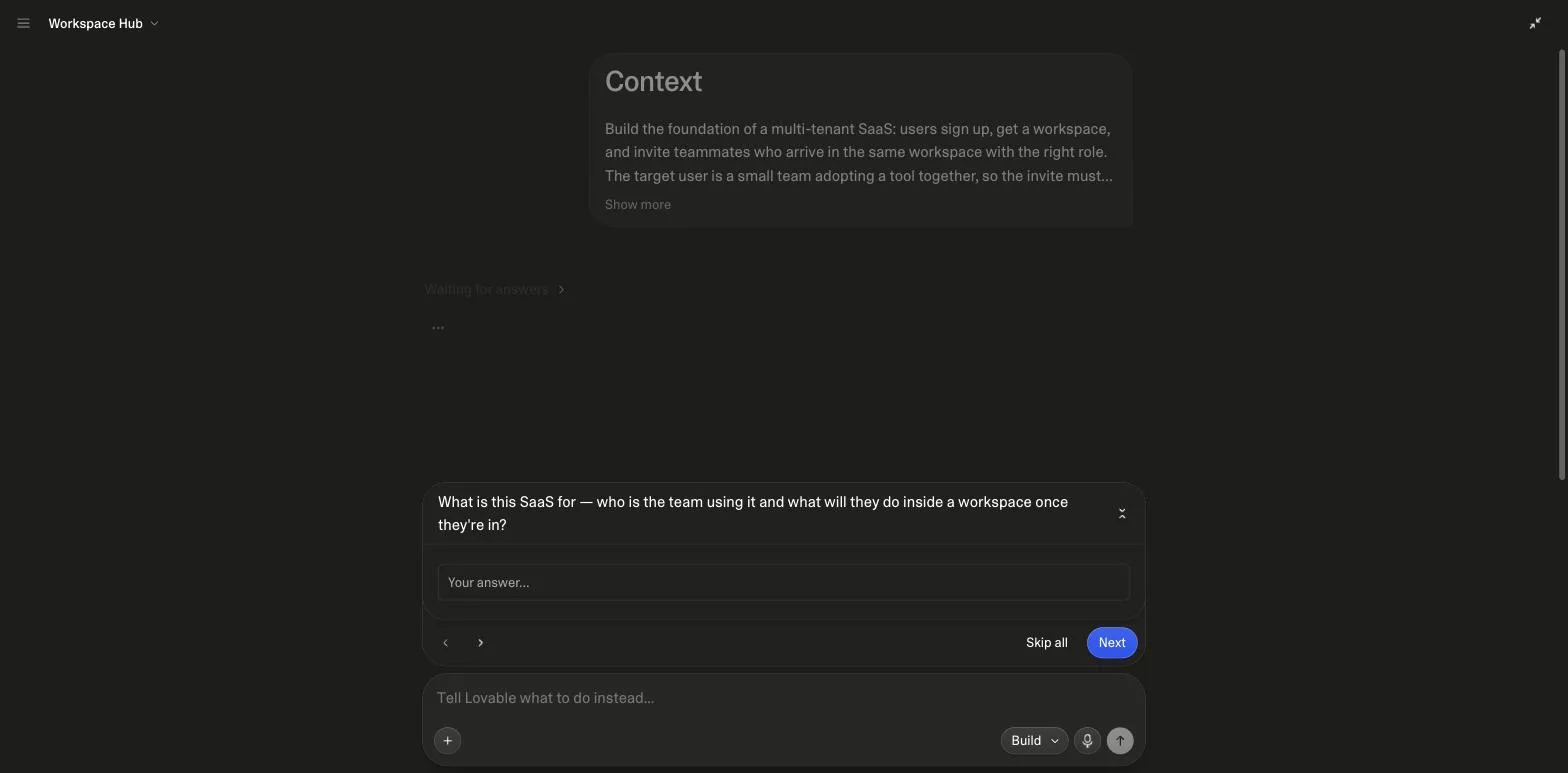
On one builder, six runs, each from a prompt in this library or a follow-up to one, each with the balance read before and after. The largest was the SaaS foundation: sign-up, workspaces, roles and invites, with the model asking four questions first, enabling Cloud on its own, and testing the invite flow before reporting. It cost 10.4 credits. The smallest was a review that changed no code, at 1.1. Across the six, the model asked 11 questions before building in the 3 runs whose prompt ended by asking for them, and none in the rest.
| Date | Questions first | Credits | What came back | |
|---|---|---|---|---|
| Landing page + opt-in | 31 Jul 2026 | 0 | 1.8 | One round, all five priority features, inline success state, Cloud enabled |
| Empty states + skeletons | 26 Sep 2026 | 2 | 9.5 | Asked 2 questions, built a /states gallery and a task list, verified slow load, failure and retry |
| SaaS MVP with auth | 26 Sep 2026 | 4 | 10.4 | Asked 4 questions, enabled Cloud, self-tested sign-up and invites, roles checked in the database |
| SEO review, no code | 26 Sep 2026 | 0 | 1.1 | 5 of 6 checks passing; the sitemap deferred until publish |
| Installable PWA | 26 Sep 2026 | 0 | 3.1 | Manifest, icons, service worker, Add to Home Screen; verified in the preview |
| SaaS landing page | 26 Sep 2026 | 5 | 4.5 | Five questions first, six minutes to a preview; server-rendered, FAQ schema, one CTA |
What a credit costs in money is on the vendor's pricing page, which is rendered in the browser and changes; the pricing guide reads it on the day, and the credits guide explains build against run credits. The number that transfers across builders is the shape: a review costs little, a screen costs some, a foundation with auth and roles costs the most, and the prompt's scope sets the bill more than its length.
Which types of AI app builder exist, and which do you need?
Five, by what they produce and what you own afterwards. The table is the decision, and the ownership column is the part to read twice: a form builder keeps your data in its account, a native builder keeps your app on its platform, a full-stack builder gives you the code, and a coding agent never had it.
| Examples | What it produces | What you own | Suits | |
|---|---|---|---|---|
| Full-stack web builder | Lovable, Bolt.new, Base44 | A web app with a database, auth and hosting from a prompt | Source code, exported or synced to GitHub | A first version of a product that people sign in to |
| Cloud IDE with an agent | Replit | The same, plus a shell and a repository you can work in | The repository | A builder who wants to read or run the code |
| Form and workflow builder | Jotform | Data-collection apps from templates and forms | Data inside the vendor's account | Internal forms, intake, approvals |
| Native mobile builder | Choicely | Store-published iOS and Android apps from templates | The app, on the vendor's platform | Media and community apps that must be in the stores |
| Coding agent | Claude Code, Cursor | Changes to a repository you already have | Everything; it is your repo | Anything after the first version, and anyone who can read a diff |
For a product people sign in to, the roundup on this site tested one full-stack builder and priced six on one day; the alternatives page says when to stay and when to leave. For a codebase you already have, the coding-agent comparison is the right page, because the full-stack builders cannot open it.
What do the vendor pages leave out?
A build. The four pages ranking for the term on 27 September 2026 carry between 4 and 74 images, a user count, a template count, a review score, and the phrase “minutes, not months” on two of them. None shows a prompt, what came back, and what it cost, which is the one thing a person choosing a builder would want to see. The chart counts what they show instead.
| Category | images |
|---|---|
| Base44 | 27 |
| Jotform | 74 |
| Choicely | 35 |
| Replit | 4 |
The four vendor pages ranking for "ai app builder", fetched 27 September 2026. Claims on each: Base44 "Trusted by 10M+ builders"; Jotform "700-plus available app templates"; Choicely "Rated 5.0 / 5 on G2, 21 verified customer reviews"; Replit "Turn your idea into an app in minutes, not months".
The claims are the vendors' own and are not repeated here as facts: Base44's builder count and Jotform's template count could not be checked against anything but the page that makes them. What this site can add is what the search side looks like from a small domain: over the last 90 days, Search Console shows 84 distinct queries containing “app builder” reaching pages here, 680 impressions and 0 clicks, every one of them a “Lovable AI app builder” long-tail phrase about prompts, the largest being “lovable ai app builder prompt best practices” at position 8.8.
That is the honest reading of the head term: people searching it want a tool to use, and the vendors' pages are the right result for them. This page is for the reader who wants to know what they are buying before the free tier asks for a prompt.
What can an AI app builder not do yet?
Open your existing code, work on two branches, take payments or send email on a free plan, keep running at a zero balance, ship a native app, or be secure without being told what secure means. Each limit below has the page it was read from; most are Lovable's because that is the builder this site documents in depth, and the comparison pages carry the equivalents for Bolt and Replit.
| What the docs say | Source | |
|---|---|---|
| Open an existing codebase | Lovable's documentation supports exporting to GitHub but NOT importing an existing repository. If your app already exists, Lovable cannot open it. | Lovable docs, via the comparison pages |
| Work on more than one branch | Lovable edits and syncs one branch at a time, which rules out most review workflows. | Lovable docs |
| Take payments on a free plan | Built-in payments: built-in payments require a paid Lovable plan; Paddle and Stripe; no API keys to handle. | Lovable payments docs |
| Send app email on a free plan | App emails need a paid plan and a verified sending domain; until then a digest is a page and a welcome email is a queue. | Lovable payments and email docs, read for the CRM and dashboard categories |
| Keep running at zero credits | At a zero credit balance, building stops, AI features in deployed apps stop working, and apps relying on the built-in backend can pause. A published static site stays up. | Lovable docs |
| Ship a native mobile app | A Lovable build runs on a phone as a web app or an installable PWA; the native path is a wrapper or an export. The Lovable app for phones is for prompting, not for the built app. | Lovable publish FAQ and mobile app docs |
| Be secure by default | Two issues are on the public record: CVE-2025-48757 covering insufficient row-level security in generated projects, and an authorisation flaw in Lovable's own API disclosed in April 2026 that allowed a free account to read another user's source and database credentials. Reporting states it was patched for new projects but not remediated for projects created before November 2025. | CVE record and 2026 disclosure, via the security guide |
The last row is the one to act on. The security guide shows the scan we ran, and the Supabase guide the three shapes a missing policy takes, including the one where a table with security on and no policies returns nothing and looks empty.
How do you get a working app out of one?
Give it the decisions it would otherwise guess, and give it a schema whose rules were proven before the first screen. The prompt that drew four questions and a self-tested invite flow on the run above has seven sections; the three highlighted are the ones a one-line prompt never contains and the ones that decide whether the app can be used by strangers.
- Context: Who signs in and what they do there.
- Core Features (Priority Order): Sign-up, workspace, invites, in that order.
- Access & Session Rules: Who can read and write what. The policy the builder will otherwise guess.
- Screens & States: Empty, loading, error, success.
- Build Order: Auth before data, data before screens.
- Safe-Guard Instructions: Never trust a role from the browser; policies in the database.
- Before Building: Ask first. This prompt drew four questions on the run.
Headings read from the prompt body of saas-mvp-auth in this library, 27 September 2026. This is the prompt behind the 10.4-credit run.
The schema half is the four kits on this site, each a prompt, a SQL file and a verification file whose queries were executed as a member and then as an owner or admin. The point of running them is in the previous section: a builder will hide a menu item and call it access control, and a query run as the wrong user is the only thing that says otherwise.
| What it is | Proof | |
|---|---|---|
| SaaS Starter | Multi-tenant workspaces, three roles, and a working invite flow, with the row-level security that makes tenancy enforced rather than cosmetic. | Six verification queries |
| Landing Page with Email Capture | One offer, one action, an indexable copy body, and the insert-only policy that stops your email list being publicly downloadable. | Seven verification queries |
| Internal Admin Dashboard | Role-gated metrics and an append-only event log, where the admin check lives in the database rather than in a hidden menu item. | Seven verification queries |
| Lightweight CRM | Companies, contacts and an append-only note timeline for a founder doing their own sales, with shared team reads and owner-only writes. | Six verification queries |
The prompt library has 151 briefs in this shape, the prompting guide explains each section, and the idea-to-app guide is the whole path from the first prompt to the first users, with distribution on day one.
Sources
Vendor pages and Lovable docs read on 27 September 2026; Lovable cross-page facts checked 26 September 2026.
- Lovable docs: Introduction and Lovable docs: Cloud.
- Base44, "AI app builder that goes from prompt to product": 27 images, no measured build.
- Jotform, "Free AI App Builder": 74 images, no measured build.
- Choicely, "AI App Builder": 35 images, no measured build.
- Replit, "The AI app builder that takes you from idea to launch": 4 images, no measured build.
- Lovable import, branch, zero-balance and security facts: the comparison pages on this site, each with its docs link, checked 26 September 2026.
- Own data: six Lovable runs in Marco's workspace (31 July and 26 September 2026), four executed kit schemas, and Search Console for this domain, 90 days to 27 September 2026.
What we did not publish
- Prices for any builder. They change weekly and two of the four vendor pages render them in the browser.
- The vendors' user, template and review counts as facts. They are quoted as claims with their source.
- Runs on Base44, Jotform, Choicely, Bolt or Replit. No accounts are created for a comparison; every measured figure here is from Lovable.
- A build-time comparison. “Minutes” is the vendors' word; our runs took five to fifteen minutes to a preview, which is stated on the pages each run links to.
Frequently asked
What is an AI app builder?↓
How is an AI app builder different from no-code?↓
How much does an AI app builder cost to use?↓
Can I build a mobile app with an AI app builder?↓
Are AI app builders secure?↓
Which AI app builder should I use?↓
Related reading
- best AI app builder
One tested, six priced on the same day.
- Lovable alternatives
When to stay and when to leave, by what you keep.
- the Lovable app builder, panel by panel
Build, Plan and Chat modes with our runs.
- whole-app prompts
Briefs with a build order, for a full app.
- Lovable vs Bolt
Two prompt-to-app builders, facts checked on one day.
- Lovable vs Replit
Builder against cloud IDE with an agent.
- Base44 alternatives
Its plans and GitHub rules quoted.
- Lovable pricing
Plans read on the day, with the check date.
- Lovable mobile app
What runs on a phone and what needs a wrapper.
- what is vibe coding
The practice the builders exist for.
Written by

Marco Kohns
Founder of ProtoBites - Venture Growth Studio
Growth PM at a Silicon Valley scale-up (a16z and General Catalyst backed), ex-Techstars where he consulted 13 early-stage startups, Reforge-trained. Every prompt on this site comes out of shipping ProtoBites' own portfolio products.