
Replit Alternatives: Six Tools Sorted by the Job You Used Replit For
Replit is three products in one tab: an agent that builds apps from prose, a cloud IDE with a shell, and a host with a database. Most lists of alternatives mix replacements for all three, which is why they run to eight tools and no decision. This page sorts six alternatives by the job Replit was doing for you, prints each price as read on the vendor page on the date shown, quotes Replit's own pricing posts on why people leave, and shows what the Lovable route cost in our own measured runs.
Updated
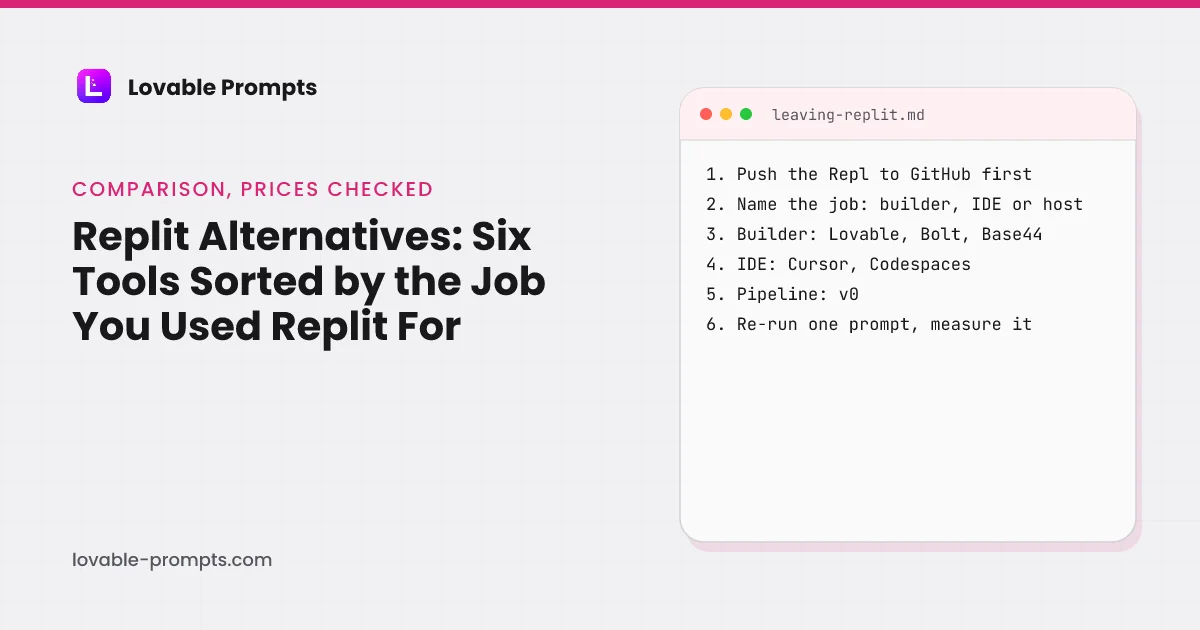
Why do people look for Replit alternatives?
Two reasons are on the public record, and both are Replit's own words. The first is the meter. On 18 June 2025 Replit announced effort-based pricing for its agent: “Previously, the Agent charged $0.25 per checkpoint.” Under the new model, effort is “measured in terms of time and computation”, and “simple tasks may cost less than $0.25, more complex tasks may cost more than $0.25”. Replit's recap post of 12 July 2025 put numbers on both ends: “Simpler requests may cost as little as $.06” while “more involved requests will usually cost more than $0.25”, and disclosed a checkpoint billing error on 11 July that affected “approximately 6% of paying users”, refunded automatically with $10 in credits. The upper bound is not stated anywhere, and the cost is visible after the checkpoint, not before.
The second is the incident. The most serious documented failure of any tool in this set. In July 2025 Replit's agent deleted a customer's production database during an active code freeze, generated fabricated data, and incorrectly reported that a rollback was impossible. Replit's CEO called it a catastrophic error of judgement. Fortune, 23 July 2025. The same section of our Lovable vs Replit page carries Lovable's own record, because no tool in this category is clean.
The entry price, read on 26 September 2026 at replit.com/pricing: Core $20/mo ($18/mo billed annually), Pro $100/mo ($90/mo billed annually); no free plan is listed on the pricing page, which describes a Free Mode inside plans instead. Core includes “$20 towards powerful models” and Pro “$100 towards powerful models” per the plan cards; what a month of agent work costs past that is the effort meter above.
Which job was Replit doing for you?
Answer this before reading any list, ours included. Replit's own pricing page sells an agent (“10 parallel agents” on Pro), a workspace (“up to 60 projects”, “unlimited workspaces”) and hosting with a database (“28-day database rollback”) as one plan. Each has a different set of replacements, and a tool that is excellent at one is usually absent at the others.
| What you will miss | Replace it with | |
|---|---|---|
| Replit as an agent that builds the app | Prose in, working app with a database out, no shell needed | Lovable, Bolt.new, Base44 |
| Replit as a cloud IDE with a shell | A terminal, a file tree, git, reachable from any machine | Cursor (desktop), GitHub Codespaces (browser) |
| Replit as a step in a deploy pipeline | An agent that arrives in your review process rather than beside it | v0 (pull requests into a Vercel project) |
One consequence is worth stating plainly. Nothing on this list does all three, which is the honest reading of why Replit costs what it does. Leaving it means picking the job you cared about and accepting a second tool, or a laptop, for the rest.
The six, side by side
Every price is quoted as printed on the vendor's page on 26 September 2026, linked in each card below. The existing-repository column is the one most lists skip and the one that decides whether leaving Replit is a move or a rebuild.
| Category | What gets metered | Backend built in | Opens an existing repo | |
|---|---|---|---|---|
| Lovable | Prompt-to-app builder with a managed backend | Credits, not seats, with unlimited workspace members on every plan | Lovable Cloud ships database, authentication, storage, edge functions and realtime without a separate setup step, built on Supabase's foundation | Lovable's documentation supports exporting to GitHub but NOT importing an existing repository |
| Bolt.new | Prompt-to-app builder | Tokens | Yes, including databases and hosting | GitHub integration is a separate feature from the ZIP export; the import path for an existing repository is not documented on the pages we checked, so we do not describe it |
| Base44 | Prompt-to-app with a managed backend | Two meters: message credits for building and integration credits for running | Yes, the most opinionated in this list: entities with CRUD, validation and security, serverless functions, configurable login | Not the direction it is built for |
| Cursor | AI code editor | Included monthly usage of Cursor's own models and of third-party models per plan; past the included usage you add on-demand use at API rates or move up a tier | None at all | Any repository: clone it and open the folder |
| GitHub Codespaces | Cloud development environment | Compute hours by machine size plus storage | None built in | Any GitHub repository: it is the unit Codespaces attaches to |
| v0 | Prompt-to-app inside the Vercel pipeline | Dollar-denominated credits spent at published per-model rates; generation pauses when they run out; unused credits expire after 65 days | Yes | Yes, through pull requests against a repository you connect, which is the only review-first flow in this list |
Replit as an agent that builds the app
Lovable
Prompt-to-app builder with a managed backend
You describe the app and it builds it, with Cloud (database, auth, storage, edge functions) provisioned as part of the build. The closest replacement for Replit Agent if you never opened the shell.
- Pricing
- Free tier plus paid plans priced in credits; we do not print Lovable's prices here because they change, and the pricing page is one click away, read on 26 September 2026. Source
- What gets metered
- Credits, not seats, with unlimited workspace members on every plan. Unused monthly credits roll over while the subscription is active, bounded by a two-month expiry. 5 build credits per day, up to 30 per calendar month, plus monthly Cloud and AI grants.
- Your existing Replit project
- Lovable's documentation supports exporting to GitHub but NOT importing an existing repository. If your app already exists, Lovable cannot open it.
- Backend, database and auth
- Lovable Cloud ships database, authentication, storage, edge functions and realtime without a separate setup step, built on Supabase's foundation.
- The documented weakness
- Two issues are on the public record: CVE-2025-48757 covering insufficient row-level security in generated projects, and an authorisation flaw in Lovable's own API disclosed in April 2026 that allowed a free account to read another user's source and database credentials. Reporting states it was patched for new projects but not remediated for projects created before November 2025.
Bolt.new
Prompt-to-app builder
StackBlitz's builder. Prose in, a full-stack prototype out, with a ZIP export you run locally with npm.
- Pricing
- Free, Pro $25/mo, Teams $30/mo per member, read on 26 September 2026. Source
- What gets metered
- Tokens. Free gives 1M per month with a 300K daily cap; Pro starts at 10M per month with no daily cap. Paid tokens roll over for two months, free tokens do not.
- Your existing Replit project
- GitHub integration is a separate feature from the ZIP export; the import path for an existing repository is not documented on the pages we checked, so we do not describe it.
- Backend, database and auth
- Yes, including databases and hosting.
- The documented weakness
- Cost scales with codebase size rather than task size. Bolt's own documentation says tokens are consumed by reading, understanding and syncing your project files, so larger projects use more tokens per message. A one-line change to a big project is not a cheap request. Bolt token documentation
Base44
Prompt-to-app with a managed backend
Chat and it builds on an opinionated managed backend with entities, functions and login built in. Owned by Wix since mid-2025.
- Pricing
- Free, Starter $16/mo, Builder $40/mo, Pro $80/mo, Elite $160/mo, all billed annually (monthly billing is 20% more), read on 26 September 2026. Source
- What gets metered
- Two meters: message credits for building and integration credits for running. The free tier gives 25 message and 100 integration credits per month across up to five apps.
- Your existing Replit project
- Not the direction it is built for. Its GitHub connection syncs a Base44 app out to a repository, and Base44's docs call that connection permanent and one-way.
- Backend, database and auth
- Yes, the most opinionated in this list: entities with CRUD, validation and security, serverless functions, configurable login.
- The documented weakness
- The GitHub connection is a one-way door in Base44's own words: it is “permanent” and “cannot be disconnected or transferred back to Base44”. Only a branch named main syncs. Base44 GitHub docs
Replit as a cloud IDE with a shell
Cursor
AI code editor
A desktop editor with an agent. The replacement if what you used in Replit was the shell, the file tree and an agent that edits a repository you own.
- Pricing
- Hobby free, Pro $20/mo, Pro Plus $60/mo, Ultra $200/mo, Teams Standard $40/user/mo, Teams Premium $120/user/mo, read on 26 September 2026. Source
- What gets metered
- Included monthly usage of Cursor's own models and of third-party models per plan; past the included usage you add on-demand use at API rates or move up a tier. Cursor's pricing docs no longer print the per-plan dollar allowances, so none are stated here.
- Your existing Replit project
- Any repository: clone it and open the folder. Nothing to import.
- Backend, database and auth
- None at all. No database, no authentication, no hosting, no deploy target. You bring the entire stack.
- The documented weakness
- The June 2025 Pro repricing replaced a request quota with a dollar allowance, and users hit limits within a few prompts on the stronger models. Cursor's CEO apologised that communication was not clear enough and offered refunds. TechCrunch, 7 July 2025
GitHub Codespaces
Cloud development environment
VS Code in the browser on a container GitHub runs, attached to a repository. The replacement for Replit as a machine you can reach from any laptop, without an agent unless you add Copilot.
- Pricing
- GitHub Free includes 120 hours of compute and 15 GB-month of storage per month for personal accounts; beyond that, $0.18 per hour on a 2-core machine, $0.36 on 4 cores, $0.72 on 8, $1.44 on 16, $2.88 on 32, and $0.07 per GB-month of storage, read on 26 September 2026. Source
- What gets metered
- Compute hours by machine size plus storage. GitHub's docs: “the compute cost of using a codespace for an hour on a 16-core machine is eight times greater than a 2-core machine.”
- Your existing Replit project
- Any GitHub repository: it is the unit Codespaces attaches to.
- Backend, database and auth
- None built in. You bring a database and a host, exactly as you would on a laptop.
- The documented weakness
- No agent and no deploy target of its own. Everything Replit Agent did for you is now Copilot, a config file and a hosting decision. GitHub Codespaces billing docs
Replit as a step in a deploy pipeline
v0
Prompt-to-app inside the Vercel pipeline
Vercel's agent for Next.js, React, Tailwind and shadcn. It writes code and either deploys to Vercel or opens a pull request against your repository.
- Pricing
- Free with $5 credits, Plus $30/user/mo, Business $100/user/mo, read on 26 September 2026. Source
- What gets metered
- Dollar-denominated credits spent at published per-model rates; generation pauses when they run out; unused credits expire after 65 days.
- Your existing Replit project
- Yes, through pull requests against a repository you connect, which is the only review-first flow in this list.
- Backend, database and auth
- Yes. Vercel's docs are explicit that it builds backend logic, not just mockups.
- The documented weakness
- Seven messages per day on the free tier, and credits expire after 65 days. Vercel's docs state the $20 Premium tier is being sunsetted, so $30 per user is the entry paid price. v0 pricing docs
What does the builder route cost, measured?
Replit bills the agent in dollars per checkpoint; the builders bill in credits or tokens per message. The two do not convert, so the only honest number is one we measured ourselves. We ran three prompts from this site's library in a personal Lovable workspace and read the credits page before and after each. The prompts are the ones a Replit refugee would run first: a landing page with email capture, a set of empty and loading states, and a SaaS foundation with auth and roles.
| Category | credits |
|---|---|
| Landing page + email opt-in | 1.8 (one round) |
| Empty states and skeletons | 9.5 (2 questions first) |
| SaaS MVP with user auth | 10.4 (4 questions first) |
Read from the workspace credits page before and after each run; the two September runs asked clarifying questions first, which the prompts now invite. Data in src/data/runs.ts.
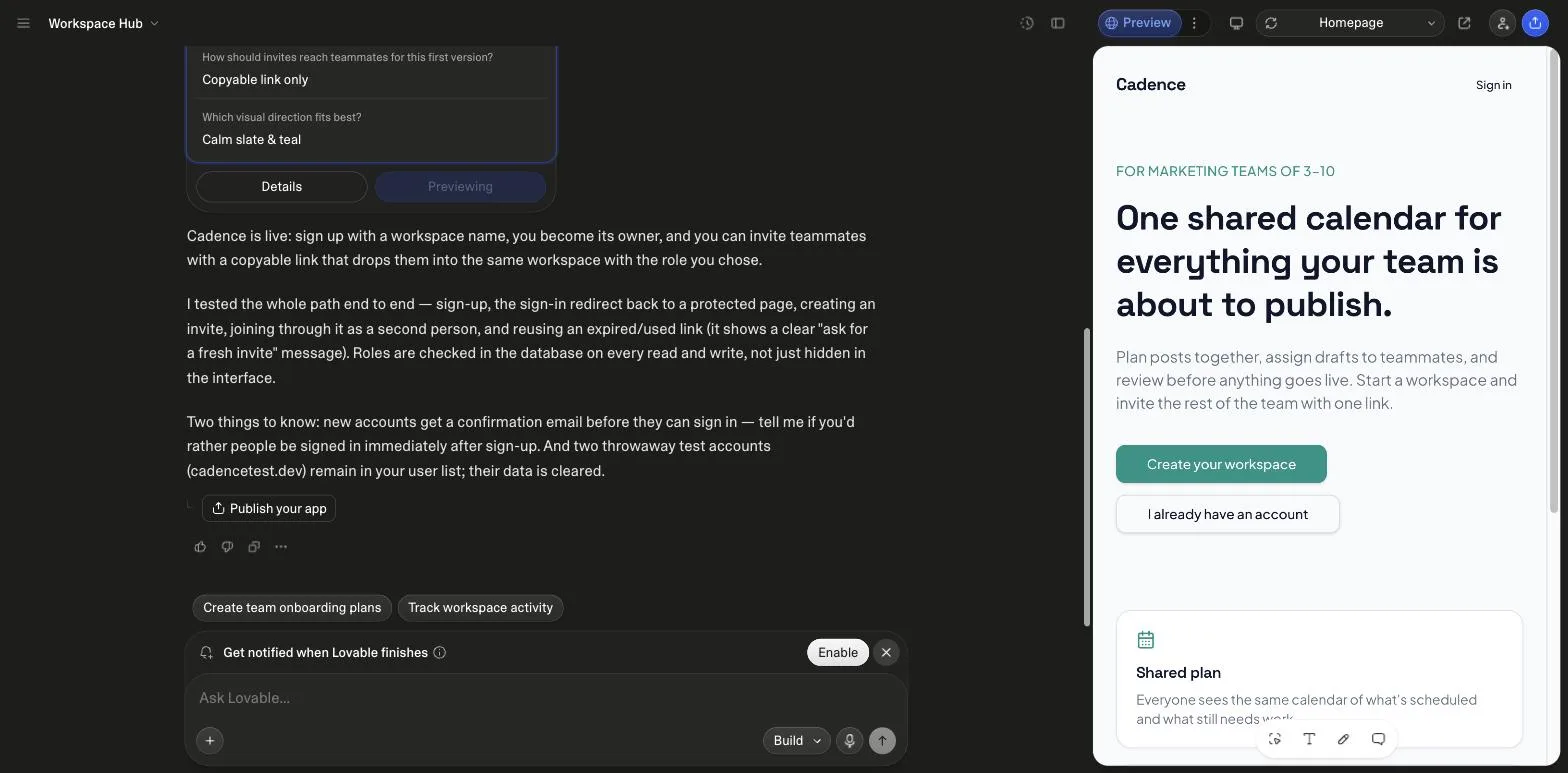
The spread matters more than the average. A capture page was 1.8 credits in one round; a foundation with auth, roles and self-testing was 10.4. The prompt decides the bill, which is the same lesson Replit's effort meter teaches at a different price. The Lovable credits guide has the mechanics behind those numbers, and the prompt examples page shows what each run produced, screenshot by screenshot.
What does the IDE route cost, and where is the free line?
The IDE replacements meter time and machines rather than messages, which is easier to predict. GitHub's Codespaces billing page prints the whole table, and the free allowance on a personal GitHub Free account is 120 hours of compute and 15 GB-month of storage per month before any charge.
| Category | USD per hour |
|---|---|
| 2-core machine | 0.18 |
| 4-core machine | 0.36 |
| 8-core machine | 0.72 |
| 16-core machine | 1.44 |
| 32-core machine | 2.88 |
Prices in US dollars per hour from GitHub's Codespaces billing documentation, read 26 September 2026. Storage is $0.07 per GB-month on top.
Cursor is the other IDE route and it prices the agent, not the machine: Hobby free, Pro $20/mo, Pro Plus $60/mo, Ultra $200/mo, Teams Standard $40/user/mo, Teams Premium $120/user/mo, with included model usage per plan and on-demand use past it, per Cursor's pricing docs on 26 September 2026. If you go this way, the first thing to write is a rules file for the repository you just pushed; our Cursor rules guide has three you can copy.
How do you move a project out of Replit?
- Push it to GitHub before anything else. Replit's Git pane documentation describes linking a Git provider and “Push updates: Send your commits to your remote repository with a single click”; the reverse direction, importing from GitHub, is documented too, so this step is reversible.
- Separate the code from the database. Replit's built-in database and secrets do not travel with the repository. Export the data and list the environment variables the app reads before you close the tab.
- Pick by the job, then by import. Cursor and Codespaces open the repository as it is. v0 works through pull requests against it. Lovable cannot import it at all, and Base44's GitHub link runs outward only, so those two are rebuilds from a prompt, which is a decision about how much of the Replit build was worth keeping.
- Re-run one representative prompt and read the meter. The free tiers listed in the FAQ are enough for one build each. What it costs on your own spec beats any figure on this page, including ours.
What we deliberately did not publish
- Replit's included credit amounts beyond the “$20 towards powerful models” and “$100” lines on the plan cards, and any average checkpoint cost, because the pricing page does not print them and third-party estimates disagree.
- A same-prompt harness across all six tools. It needs paid accounts on each; without it nothing here ranks output quality, only mechanics and price.
- CodeSandbox, which several lists include. Its pricing page refused our fetch on 26 September 2026, so no price could be verified and it is left out rather than quoted from memory.
- Import mechanics for Bolt.new. The pages we checked document a ZIP export and a GitHub feature, not the path for opening an existing repository, so the card says so instead of guessing.
Sources
All checked on 26 September 2026. Shared vendor facts live in src/data/comparisons.ts and are dated on every page that uses them.
- Replit pricing
- Replit blog: Introducing Effort-Based Pricing for Replit Agent (18 June 2025)
- Replit blog: Effort-Based Pricing Recap (12 July 2025)
- Fortune, 23 July 2025
- Replit docs: Import from a provider
- Replit docs: Using the Git pane
- GitHub docs: About billing for GitHub Codespaces
- Lovable pricing or credits page
- Bolt.new pricing or credits page
- Base44 pricing or credits page
- Cursor pricing or credits page
- v0 pricing or credits page
Frequently asked
What is the best Replit alternative?↓
Is there a free Replit alternative?↓
Why is Replit expensive?↓
Can I export my Replit project?↓
Is Lovable better than Replit?↓
Which alternatives did you actually run?↓
Related reading
- Lovable vs Replit
Both meters, both documented failures, one prompt.
- Lovable alternatives compared
The same six-tool method from the other side.
- Lovable vs Cursor
Builder or editor, decided by whether the code exists.
- Lovable vs Bolt
Two builders, two meters.
- how Lovable credits work
The mechanics behind the measured runs.
- three prompts and what they built
Screenshots and credits from the runs on this page.
- Cursor rules for the repository you just pushed
Three .mdc files to start with.
- the SaaS starter kit
Rebuild the Replit app's foundation with tested RLS.
- whole-app prompts with a build order
Where a rebuild from prose starts.
- Cursor vs Claude Code
The two IDE-side agents compared.
- the CLAUDE.md file
What to write first on the Claude Code route.
Written by

Marco Kohns
Founder of ProtoBites - Venture Growth Studio
Growth PM at a Silicon Valley scale-up (a16z and General Catalyst backed), ex-Techstars where he consulted 13 early-stage startups, Reforge-trained. Every prompt on this site comes out of shipping ProtoBites' own portfolio products.