
Product-Channel Fit: Why the Channel Shapes the App You Prompt
Most generated apps are built first and distributed later, and the second step never happens, because the app was not shaped for any channel. Product-channel fit is the name for doing it the other way round. This guide explains the idea in its author's terms, shows how the channel changes a Lovable prompt, and charts how every prompt in the library carries one.
Updated
What is product-channel fit, in its author's terms?
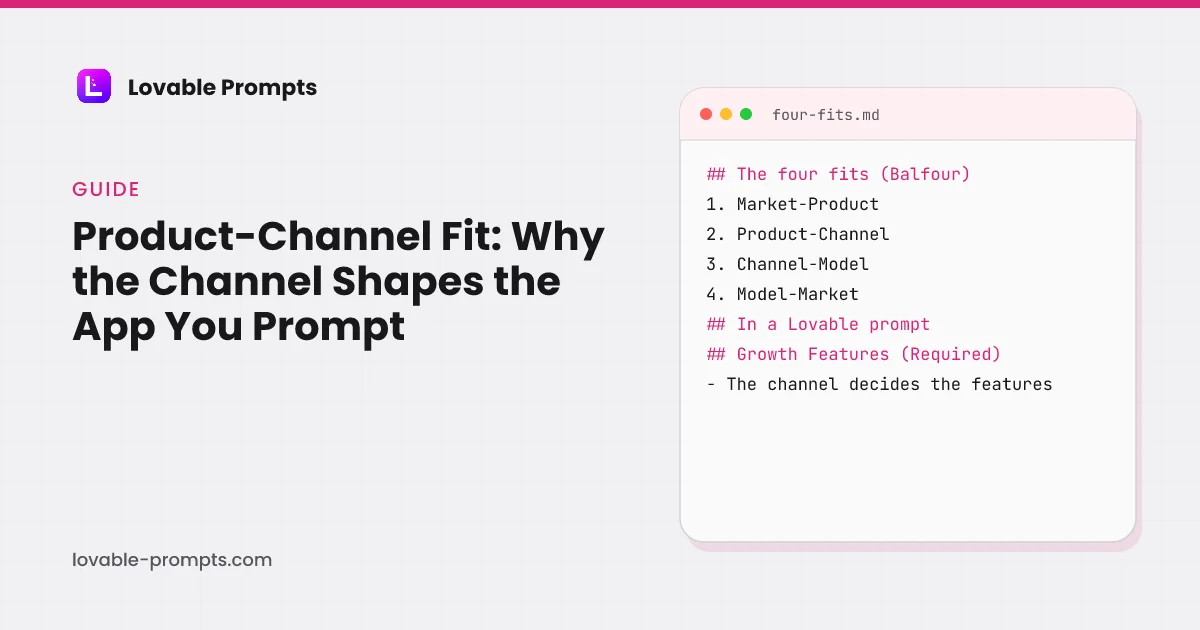
The framework comes from Brian Balfour's essay Product Channel Fit Will Make or Break Your Growth Strategy, one of a series on what he calls the four fits (read on 26 September 2026). Its core claim is that products are built to fit channels, not channels to fit products, because the channel owner sets the rules: search rewards pages that answer queries and earn links, a product-led loop rewards products that are better with more people in them, a marketplace or community rewards an artifact worth posting. A team that builds the product first and then asks which channel it fits has the order backwards, and usually finds it fits none.
- Market-product: a problem worth solving
- Product-channel: shaped for its channel
- Channel-model: channel pays for itself
- Model-market: price fits the market
Framework from Brian Balfour's four-fits essays, read on 26 September 2026. The second fit is the subject of this page.
For a first app the second fit is the one you can act on in the prompt, because it is a set of features. The other three are decisions about pricing and market that a prompt cannot make for you, though the SaaS prompts in the library keep entitlement and billing separate for exactly that reason.
How does the channel change what the prompt asks for?
Concretely, and per channel. The table is the short version of the ten channels the library maps prompts to; each row is a feature the app needs before that channel can work, and none of them is decoration.
| What the app must contain | |
|---|---|
| Organic SEO / AI Search | Design your product so it naturally attracts traffic by creating pages that directly answer what users are already searching for and get picked up by Google and AI search engines. |
| Paid Search | Get a prompt that optimizes your product for fast perceived value and clear conversion paths so ad clicks have a fighting chance to pay back. |
| Organic Socials | Shape your product around outputs people actually want to share, not because you ask them to, but because it makes them look smart or helpful. |
| Paid Socials | Structure your product so its value is instantly understandable in a scroll, making it viable to acquire users even when attention is expensive. |
| Short-Form Video | Build your product around moments that can be shown, not explained, so it works naturally in short, visual formats like TikTok or Reels. |
| Product-led Growth | Create a product experience where users reach a meaningful 'aha moment' before they ever have to sign up, pay, or talk to sales. |
| Community-led Growth | Design your product so users benefit from contributing, sharing, or improving it together, causing value to compound over time. |
| B2B Sales / Outreach / LinkedIn | Get a product structure that can be explained in one message and clearly ties features to business outcomes decision-makers care about. |
| X (Twitter) | Give the product a visible artifact worth posting, so building in public produces something to show rather than something to announce. |
| Email Marketing | Build a reason for the product to send something a user actually wants to open, so the list becomes a retention channel rather than a broadcast list. |
Here is the same idea as a prompt. The first version is what most people type; the second is the same app shaped for one channel.
Without a channel
“Build a habit tracking app with daily check-ins, streaks, and reminders.”
Shaped for organic search
Build a habit tracking app that grows through organic search.
Distribution channel: Organic SEO
- Public habit template pages, each its own indexable URL with a title and structured data
- A comparison page per well-known tracker
- A shareable progress card users can post
Core features (priority order):
1. Daily check-ins with streaks
2. Pre-built habit templates, one page each
3. Shareable progress graphics
Conversion path: browse and use templates free; sign up to save progress; Pro for analytics
How does the library encode a channel into every prompt?
151 of the 151 prompts are mapped to at least one channel, computed from the prompt bodies when the site is built, and every Pro variant carries a Growth Features section written for that channel. The chart counts primary and secondary coverage; the note gives the number where the channel is the prompt's primary one.
| Category | prompts |
|---|---|
| Product-led Growth | 81 (65 primary) |
| Email Marketing | 62 (14 primary) |
| B2B Sales | 54 (19 primary) |
| Organic SEO | 44 (22 primary) |
| Community-led Growth | 33 (9 primary) |
| Organic Socials | 24 (7 primary) |
| Paid Search | 9 (5 primary) |
| Paid Socials | 4 (0 primary) |
Computed from the channel mapping in each prompt at build time, 151 prompts; a prompt can serve more than one channel.
Product-led growth dominates because most first apps grow through the product, and because it is the channel a prompt can do the most for: an invite, a share or a public page is code. The category pages carry the same chart per category, and the first-100-users guide turns the chosen channel into a playbook.
How do you choose the channel?
One channel, chosen on three things: where your users already look for a solution, what you can sustain for a month without traffic, and what the product naturally produces. Writing and patience point at search. A product that is better with more people in it points at product-led growth. Being genuinely useful in two or three places points at community. Budget plus a measurable page points at paid. Commit to it for the first hundred users and change it only on evidence, because a channel takes weeks to prove and switching resets the clock.
If you would rather start from a prompt that already carries a channel, the library groups them by category and names the channel on every card, and the generator asks for the channel before it writes one.
Sources
- Brian Balfour: Product Channel Fit Will Make or Break Your Growth Strategy, read on 26 September 2026
What changed
- 26 September 2026: rebuilt as a server-rendered guide around Balfour's essay with the four-fits flow, a channel requirements table, the library's channel chart computed from the data, four FAQs, hero and sources; the unsourced startup-failure opening is gone.
Frequently asked
What is product-channel fit?↓
Why does the channel belong in a Lovable prompt at all?↓
How does the library encode this?↓
Which channel should I pick?↓
Related reading
- the first 100 users
Turning the channel into a playbook.
- the prompting handbook
Balfour's fits, applied to prompts.
- landing page prompts
Built for one traffic source.
- SaaS prompts
Product-led loops in the prompt.
- app builder prompts
Thirty apps, each mapped to a channel.
- UI prompts with share moments
Organic social in the interface.
- integration prompts
Community and product-led mechanics.
- how to write the prompt
The section that carries the channel.
- the landing page kit
A capture page shaped for one source.
- idea to app, the path we measured
Channel first, then the prompt, then the build in credits.
- vibe coding prompts by channel
Ten first prompts, one channel each.
- best AI app builder
Which builder ships which surface.
- app ideas
Fifty ideas sorted by the channel that gets them users.
- SaaS landing page prompt
One page for one source: the prompt and its run.
- Product Hunt launch
A launch as a day of traffic aimed at a URL.
- how to build an MVP
A finished MVP with no users yet: the case for this page.
Written by

Marco Kohns
Founder of ProtoBites - Venture Growth Studio
Growth PM at a Silicon Valley scale-up (a16z and General Catalyst backed), ex-Techstars where he consulted 13 early-stage startups, Reforge-trained. Every prompt on this site comes out of shipping ProtoBites' own portfolio products.