
Lovable vs v0: Same Category Now, Different Stack, Meter and Exit
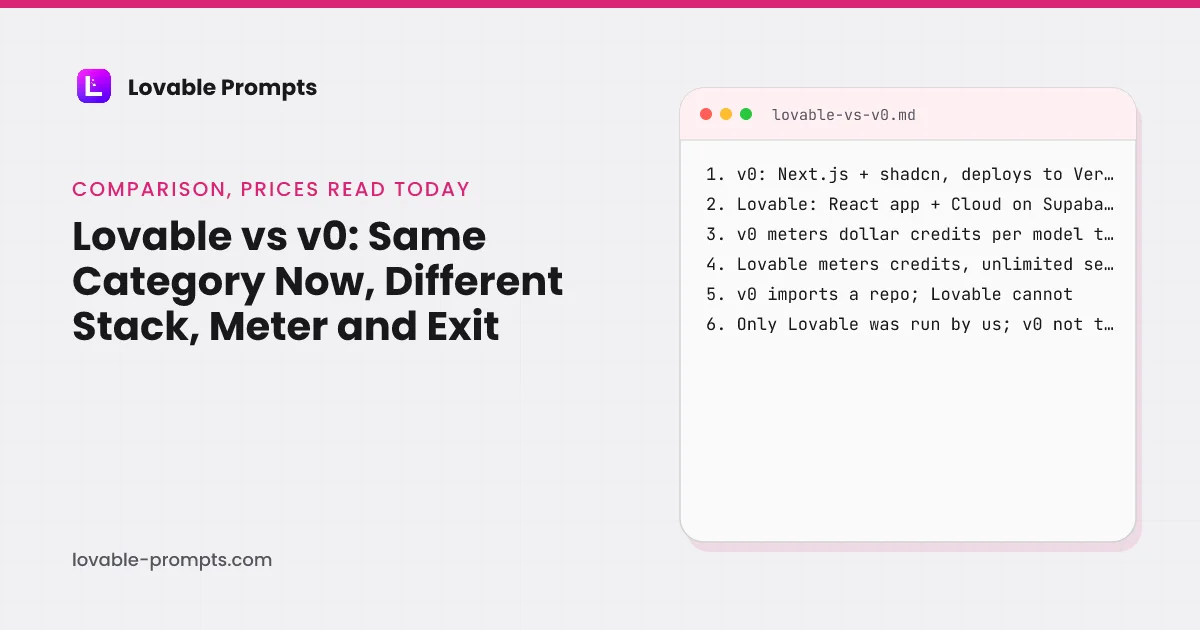
Every top result for this comparison says v0 makes components and Lovable makes apps. v0's own documentation stopped agreeing with that some time ago: it now says full-stack with authentication and databases, imports a GitHub repository, and deploys to Vercel. So the choice is not scope. It is which stack you want to own, what each meter counts, and how you leave. Prices and docs were read the day this was written; only Lovable was run by us.
Updated
Is v0 still a component generator?
No, by the vendor's own words on 26 September 2026. The v0 FAQ, under “Can v0 build full-stack or complex applications?”: “Yes. v0 handles everything from simple components to full-stack apps with authentication, databases, and external API integrations.” The stack: “v0 uses Next.js, React, TypeScript, Tailwind CSS, and shadcn/ui.” The databases page lists Upstash, Neon, Supabase, and Vercel Blob as one-click integrations, and says v0 “provisions a new user account on that service and adds the necessary environment variables to your project”. The full-stack page adds the caveat that decides the stack question: “While v0 can use other frameworks, Next.js provides the most reliable results”.
Lovable's side of the same question: Lovable Cloud ships database, authentication, storage, edge functions and realtime without a separate setup step, built on Supabase's foundation. The difference is not whether either can build a backend. It is that v0's backend is Next.js route handlers and server actions on Vercel with a provider you pick from a marketplace, and Lovable's is a managed Supabase-shaped Cloud that is on by default.
Side by side
| Lovable | v0 by Vercel | |
|---|---|---|
| Default stack | React app; backend on Lovable Cloud, built on Supabase's foundation | Next.js, React, TypeScript, Tailwind, shadcn/ui; other frameworks work, Next.js most reliable |
| Backend | Lovable Cloud ships database, authentication, storage, edge functions and realtime without a separate setup step, built on Supabase's foundation. | API routes and server actions; Upstash, Neon, Supabase, Vercel Blob provisioned from a marketplace |
| Hosting | Lovable publishes and hosts; custom domains on paid plans | v0 deploys projects to Vercel. Export and deploy elsewhere is stated as possible. |
| What gets metered | Credits, not seats, with unlimited workspace members on every plan. Unused monthly credits roll over while the subscription is active, bounded by a two-month expiry. | Dollar credits spent per token at per-model rates; monthly credits expire after 65 days |
| Free tier | 5 build credits per day, up to 30 per calendar month, plus monthly Cloud and AI grants. | $5 of monthly credits, 7 messages a day, Design Mode and GitHub sync included |
| Team billing | Credits, unlimited workspace members | Per user: Plus $30, Business $100, each with $30 of credits per user |
| Bring a codebase | Lovable's documentation supports exporting to GitHub but NOT importing an existing repository. If your app already exists, Lovable cannot open it. | Git import: a chat against an existing repository with a working branch and preview deployment |
| Getting the code out | Two-way GitHub and GitLab sync: changes flow in both directions, and you can clone and work locally. | Two-way GitHub sync; Publish opens or reuses a pull request and merges it |
| Visual editing | Visual edits in the preview; Plan and Build modes in chat | Design Mode: select an element in the preview, edit styles or describe the change; latest runtime only, not on mobile viewports |
| Code ownership | Yours; sync to your repo | "Vercel doesn't own the code generated based on your queries and prompts." |
v0 facts from its docs, GitHub, Git import, deployments and Design mode pages; Lovable facts from the shared file behind all four comparison pages, checked 26 September 2026.
What does each one cost, read today?
v0's pricing page is client-rendered, so the plan cards were read in a browser on 26 September 2026; the expiry rules come from its docs pricing page. Lovable's plans were read the same day for the pricing guide.
| Price | Included credits | Daily rule | Also | |
|---|---|---|---|---|
| Free | $0 | $5 of included monthly credits | 7 message/day limit | Design Mode, GitHub sync |
| Plus | $30 per user per month on the docs pricing page; the plan card prints $30 and $90 side by side with no label in the page text | $30 of included monthly credits per user | $2 of free daily credits on login per user | Team credit purchasing, centralized billing |
| Business | $100 per user per month | $30 of included monthly credits per user | $2 of free daily credits on login per user | Training opt-out by default |
| Enterprise | Custom | Custom | Custom | SAML SSO, RBAC, SLAs |
Two rules shape the v0 bill more than the sticker: “Unused monthly credits roll over to the next billing cycle and expire after 65 days”, purchased credits “expire one year after purchase”, and “The number of tokens per credit used depends on the model.” That last line means the same prompt costs different amounts depending on the model picker, which the Free tier does not fully expose.
| Category | USD |
|---|---|
| v0 Plus, 3 users | 90 (3 x $30) |
| Lovable Pro, 3 members | 25 (1 workspace) |
| v0 Business, 3 users | 300 (3 x $100) |
| Lovable Business, 3 members | 50 (1 workspace) |
v0 Plus at $30 per user per month (docs pricing page) against Lovable Pro at $25 per workspace with unlimited members, both read 26 September 2026. Credits included differ and are not compared here.
The chart is seats, not work: each v0 user brings $30 of credits, Lovable Pro brings 100 credits for the workspace. Whether 100 Lovable credits or $90 of v0 credits builds more is the question we could not answer without running v0, so it is not answered here.
What did we measure, and on which side?
Lovable only. Three library prompts, credits read from the billing page before and after each run.
| Category | credits |
|---|---|
| Landing page + email opt-in | 1.8 (2026-07-31) |
| Empty states and skeletons | 9.5 (2026-09-26) |
| SaaS MVP with user auth | 10.4 (2026-09-26) |
Read from the workspace credits page on the day of each run. No v0 run exists; the account in the browser was not signed in and we do not create accounts for a comparison.
The screenshots and what each run returned are on the prompt examples page. The v0 equivalent would be the same prompts pasted at v0.app with the model picker on its default, and the dollar credits read before and after. That is the test this page is missing, and the reason its verdict is about structure rather than output.
When v0 is the better choice
- You already have a repository. Lovable's documentation supports exporting to GitHub but NOT importing an existing repository. If your app already exists, Lovable cannot open it. v0's Git import opens a chat against it.
- Your production is Vercel and Next.js. v0 writes the framework Vercel runs best and publishes through a pull request into the branch you already deploy.
- You want to pick the model. Per-model token pricing is a cost lever Lovable's credit model does not expose.
When Lovable is
- More than one person is building. Credits, not seats, with unlimited workspace members on every plan. Unused monthly credits roll over while the subscription is active, bounded by a two-month expiry. v0 bills every seat.
- Nobody on the team will open the code. Cloud is on by default, Plan mode is a cheap place to think, and the built-in payments, security scans and SEO review live in the same chat.
- You want a measured baseline. Three runs on this site have credits and screenshots attached; you can price a build before starting it.
The counterweights, stated plainly: Lovable edits and syncs one branch at a time, which rules out most review workflows. Lovable cannot save files larger than 10 MB. And At a zero credit balance, building stops, AI features in deployed apps stop working, and apps relying on the built-in backend can pause. A published static site stays up.
What do the top results for this term leave out?
- Vercel, v0 vs Lovable. About 3,200 words, eight-row table, no prices ('worth checking the live page'), no test. Says Lovable lacks native Next.js, a Python backend and repo import.
- Lovable, Lovable vs V0. About 2,100 words, published 5 March 2026, prices as of 26 February 2026 including a $20 v0 Premium tier the pricing page no longer shows. No test.
- No Code MBA, Lovable vs V0 2026. About 1,300 words, updated 19 May 2026, one prompt (a job board UI) in both with screenshots, no prices, no backend comparison.
- Softr, v0 vs Lovable. About 4,500 words, lists a $20 v0 Premium tier and Lovable 'Pro $25 for 100 messages'; verdict recommends Softr.
What we did not publish
- A v0 run. The browser was not signed in to v0 and we do not create accounts to make a comparison.
- A verdict on output quality. Without the same prompt on both sides, there is no honest one.
- The v0 Plus card's second figure. The card printed $30 and $90 side by side with no label in the page text we read; the docs pricing page says $30, so that is the number used.
Also worth comparing
Lovable versus Bolt for the other same-category builder, Lovable versus Cursor if you already have a codebase and want an editor rather than a builder, and the full set in the alternatives comparison. The best AI app builder page puts six of them on backend, code out and meter.
Sources
All read on 26 September 2026. Quotes in src/data/lovableVsV0.ts; Lovable facts in src/data/comparisons.ts.
Frequently asked
Is v0 only a UI component generator?↓
What does v0 cost compared with Lovable?↓
Can I bring an existing codebase?↓
Where do the apps run?↓
Which one did you actually run?↓
Which should a non-developer pick?↓
Related reading
- Lovable vs Bolt
The other same-category builder, on what the meter counts.
- Lovable vs Cursor
Editor versus builder when you already have code.
- Lovable vs Replit
IDE around the agent, effort-based billing.
- Lovable alternatives
The full set, priced the same day.
- best AI app builder
Six builders on backend, code out and meter.
- Lovable pricing
The Lovable side of the seat comparison.
- how Lovable credits work
The three measured runs behind the chart.
- three prompts and what they built
Screenshots for each Lovable run.
- AI coding tools compared
Where v0 sits among the builders and agents.
- landing page prompts by traffic source
The 1.8-credit run's prompt.
- Bolt vs Cursor
The other pair: a builder against an editor.
Written by

Marco Kohns
Founder of ProtoBites - Venture Growth Studio
Growth PM at a Silicon Valley scale-up (a16z and General Catalyst backed), ex-Techstars where he consulted 13 early-stage startups, Reforge-trained. Every prompt on this site comes out of shipping ProtoBites' own portfolio products.