
SaaS Landing Page Prompt: The Section Spec, Run in Lovable, With the Page It Built
Search for a SaaS landing page and you get galleries: hundreds of screenshots and no method. This page is the method as a prompt, six sections in the order a cold visitor reads them, with the rules that keep the page honest, run in Lovable the day it was written. What Lovable asked first, what it built, what it cost, and where the output missed the spec are all below.
Updated
What does the page have to do, section by section?
Turn a cold visitor from one source into a trial sign-up, and nothing else. Unbounce's examples post (updated 14 August 2025, read 26 September 2026) lists the elements as USP, hero, design, features and benefits, social proof, a demo, CTA, forms and mobile; its benchmark from 44,000 pages puts SaaS at a 9.5% average and a 3.0% median conversion rate. The list is right and unordered. The order is what the prompt adds.
- Hero: outcome + one CTA
- Problem: their words
- Features: as outcomes
- Pricing: one config
- FAQ: with schema
- Final CTA: same one
The prompt on this page, condensed.
| Must contain | Rule | |
|---|---|---|
| Hero | An outcome headline, one sentence of how, one CTA, one proof line | Proof is a marked placeholder until it is true |
| Problem | Three pains in the visitor's words, then the product as the answer | No feature names before the pains |
| Features | Headings in the form [result] without [cost], one sentence, one screenshot slot | Fixed aspect ratios so nothing shifts |
| Pricing | Two or three plans plus a comparison table | Both read one config object; limits are never retyped |
| FAQ | Six questions that stall a sign-up | FAQPage structured data in the HTML |
| Final CTA | The hero's action again | Nothing new introduced |
The prompt
Written in the library's shape: context, features in priority order, rules, build order, safeguards, and the closer that makes Lovable ask before building. Swap the product and visitor lines for yours.
# Context
Build the marketing landing page for a SaaS product: one page whose job is to turn a cold visitor from one traffic source into a trial sign-up. The product is Cadence, a shared content calendar for marketing teams of 3 to 10; the visitor is a marketing lead arriving from a LinkedIn post. Server-rendered throughout so the copy can rank.

## Core Features (Priority Order)
1. Hero: an outcome headline (what changes for the visitor), one sentence of how, one primary CTA, one proof line marked as a placeholder
2. Problem block: three concrete pains in the visitor's words, then the product as the answer
3. Features written as outcomes: each feature is a heading in the form "[result] without [cost]", one sentence, one screenshot placeholder with a fixed aspect ratio
4. Pricing: two or three plans reading their limits from one config object; the same object drives the comparison table
5. FAQ: six questions that stall a sign-up, marked up as FAQPage structured data
6. Final CTA repeating the hero's, and nothing else new

## Copy & Conversion
- One primary action on the page; secondary links go to docs or pricing anchors only
- Proof elements are placeholders clearly marked as placeholders; never invent names, logos or numbers
- Maximum 65 characters per line of body copy; headings state results, not nouns

## Technical Requirements
- Real title, meta description, canonical and Open Graph tags; the body copy is text in the HTML, not an image or a client-only block
- Mobile first; the comparison table scrolls inside its own container
- No layout shift when images load

## Build Order
Final copy as static sections first, so there is something to index. Then the pricing config and the components that read it. Then FAQ and schema. CTA wiring to the sign-up route last.

## Safe-Guard Instructions
- Do not add a second call-to-action type: no newsletter box, no chat widget, no exit popup
- Every limit shown in the pricing section is imported from the config, never retyped
- No alert() dialogs and no modals for anything on this page

## Before Building
Ask me any questions you need in order to fully understand the audience and the offer, then save the decisions to the project knowledge so later prompts build on them.
What happened when we ran it?
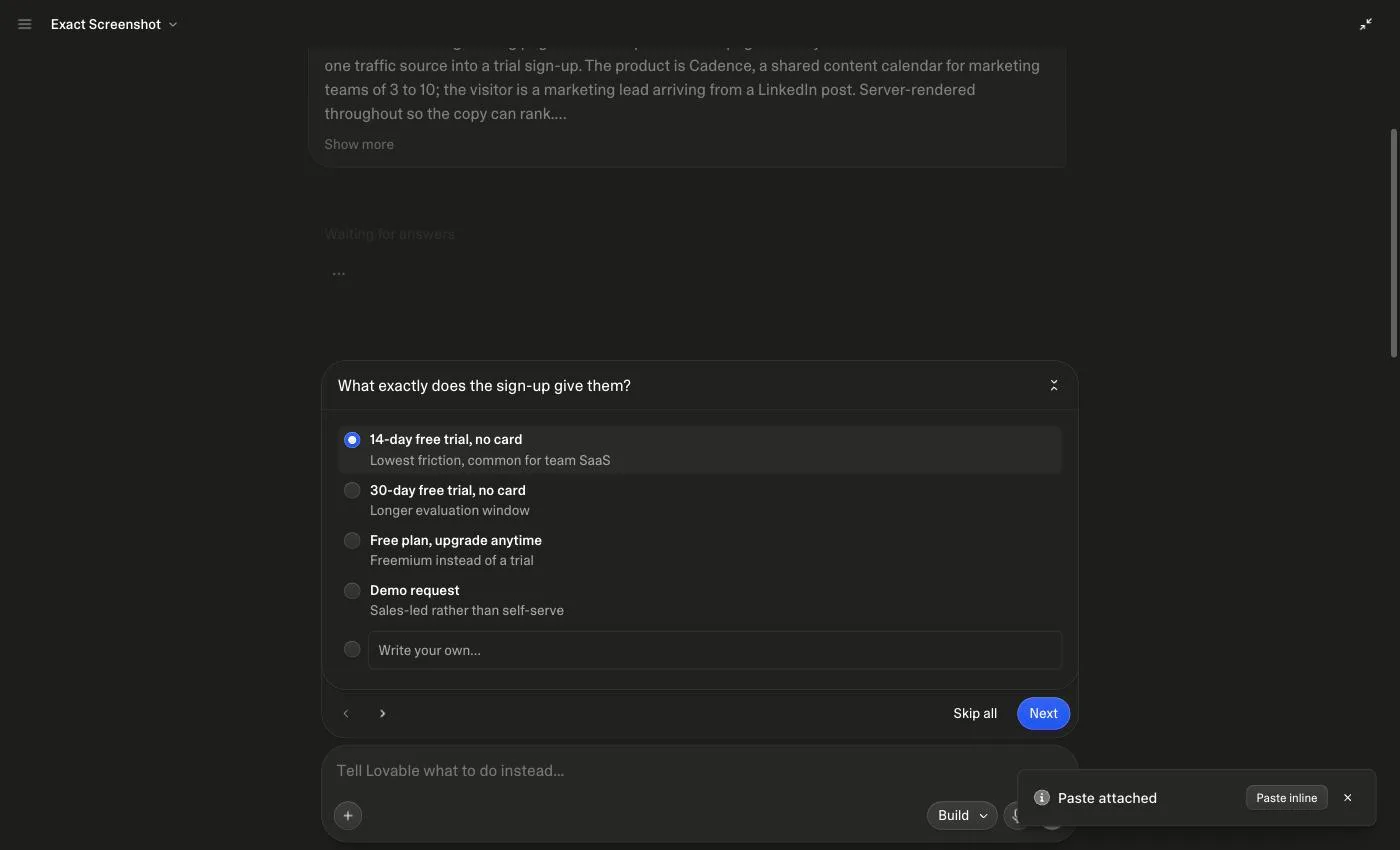
Pasted as one message into a new project in Marco's personal Lovable workspace on 26 September 2026. Lovable asked 5 questions before building; the answers given: What exactly does the sign-up give them? 14-day free trial, no card (the default); How should the plans be structured? Two plans, Team and Business (the default); Which pain should the page lead with? Calendar lives in scattered spreadsheets (the default); Any brand details I should use? Left blank, so it picked placeholders; Which design direction should I build? Two rendered mockups offered; the first, Newsroom grid planner, selected.
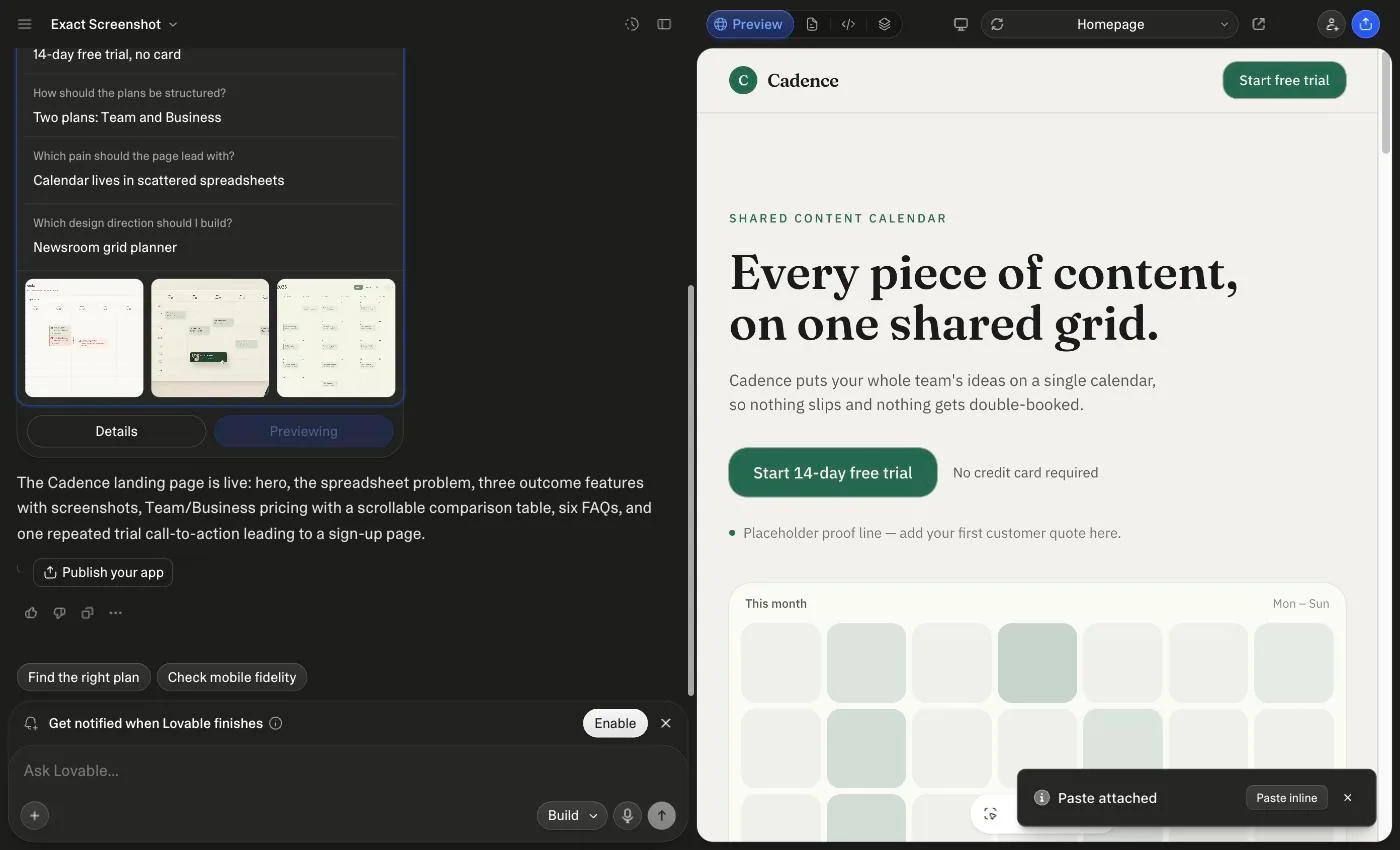
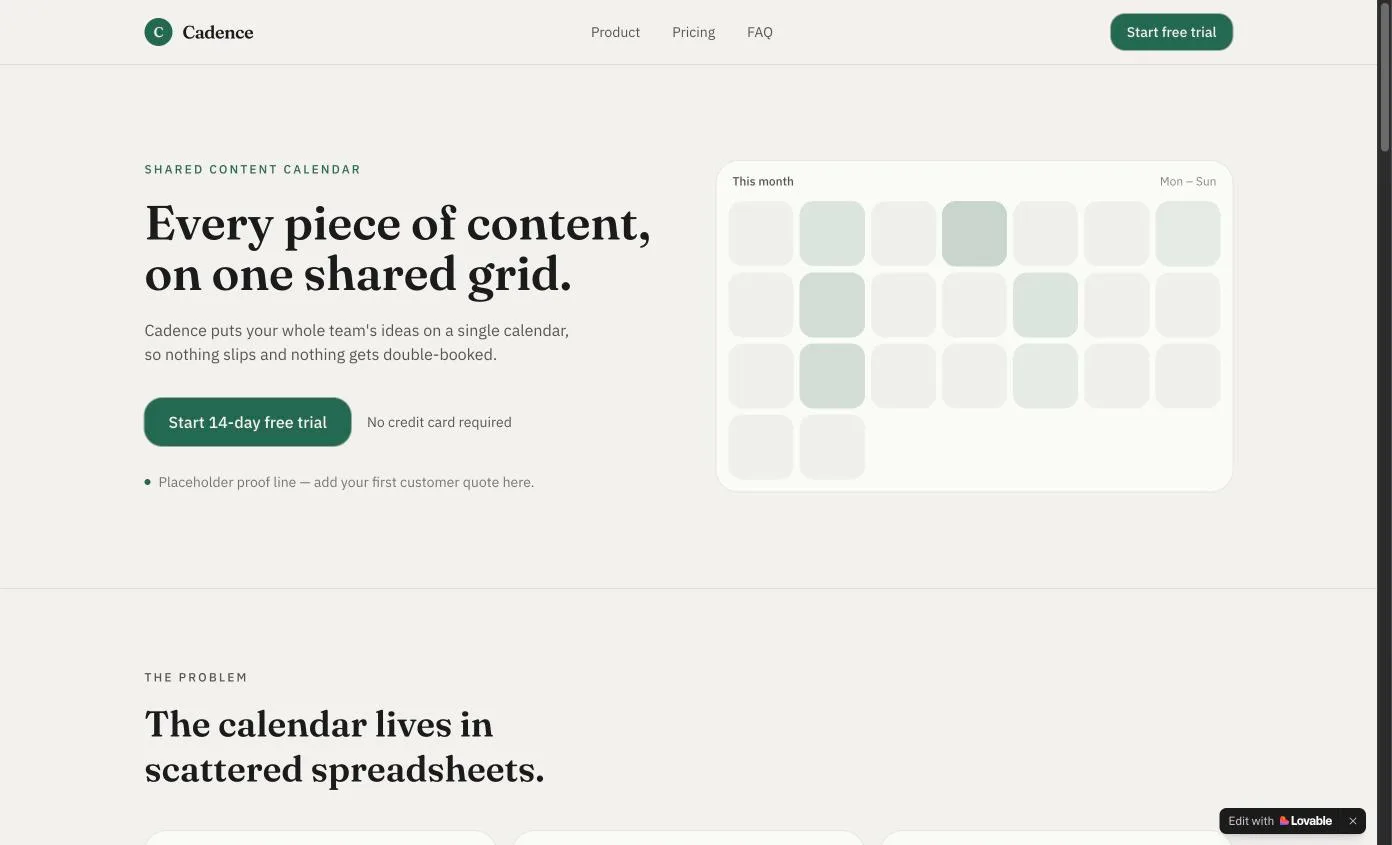
Build started 19:22 and was finished by 19:28. Lovable's summary: "The Cadence landing page is live: hero, the spreadsheet problem, three outcome features with screenshots, Team/Business pricing with a scrollable comparison table, six FAQs, and one repeated trial call-to-action leading to a sign-up page." The hero reads "Every piece of content, on one shared grid." with one button, "Start 14-day free trial", the line "No credit card required", and a proof line that says it is a placeholder. The billing page lists the project at 4.44 credits; the balance moved 56.9 to 52.4.
| Result | |
|---|---|
| Server-rendered copy | Yes: the raw HTML fetched from the signed-in tab is 39,298 bytes with one h1 containing the headline text, one ld+json block and one table; anonymous requests get 401 because previews are private |
| Title, description, canonical, Open Graph | All present; title "Cadence, one shared content calendar for your team", canonical pointing at the preview URL |
| Hero: outcome headline, one sentence, one CTA, proof placeholder | "Every piece of content, on one shared grid.", one sentence of how, one button, and a proof line that reads as a placeholder |
| Problem block, three pains in the visitor's words | H2 "The calendar lives in scattered spreadsheets." with three H3s: no single source of truth, deadlines surface too late, ownership is fuzzy |
| Features as [result] without [cost] | Three H3s in exactly that form, e.g. "Spot conflicts without a weekly status meeting"; three 1280x720 image slots with a fixed aspect ratio |
| Pricing: two plans plus a comparison table | Team and Business cards and a table inside an overflow-x-auto container; whether both read one config object was not checked in the code |
| FAQ: six questions with FAQPage schema | Six questions, one FAQPage ld+json block |
| One CTA type only | Four buttons on the page, all Start free trial or Start 14-day free trial; no form, no newsletter box, no chat widget |
| Body copy length | 394 words on the page: enough to convert, thin to rank; the ranking job belongs to the SEO landing prompt |
Cost, read from the billing page: 56.9 credits before, 52.4 after, 4.5 for the run.
How does this run compare with the other measured runs?
| Category | credits |
|---|---|
| Landing page + email opt-in | 1.8 (2026-07-31) |
| Empty states and skeletons | 9.5 (2026-09-26) |
| SaaS MVP with user auth | 10.4 (2026-09-26) |
src/data/runs.ts, read from the workspace credits page on the day of each run.
The credits guide explains what the numbers pay for; the prompt examples page has the other runs' screenshots. The landing page prompts category holds the email opt-in, pricing page and SEO landing prompts this one borrows its rules from, and the landing page kit adds the leads table with its insert-only policy.
What do the top results for this term leave out?
- Lapa Ninja, Saaspo, Dribbble, Behance. Galleries of hundreds to thousands of screenshots. Inspiration, no method, no build.
- Unbounce, 27 best SaaS landing page examples. About 8,500 words, 27 screenshots, the benchmark figures cited above, an unordered element list, and templates that assume its own builder.
What we did not publish
- A conversion rate for the page we built. It was never published to traffic, so it has none.
- Copy claims for a product. The run used the fictional Cadence with proof lines marked as placeholders, as the prompt requires.
- A design verdict. Whether the page looks good is not measured; whether it contains what the spec asked for is, above.
Sources
All read on 26 September 2026. The prompt and run in src/data/saasLandingPrompt.ts.
Frequently asked
What sections does a SaaS landing page need?↓
What conversion rate should a SaaS landing page get?↓
Why one CTA?↓
Why must pricing read from a config object?↓
What did the run cost, and what did it build?↓
Does the page rank?↓
Related reading
- landing page prompts by traffic source
The opt-in, pricing and SEO prompts this one borrows from.
- landing page kit
The leads table with an insert-only policy.
- three prompts and what they built
The other measured runs.
- how Lovable credits work
What the run's credits paid for.
- Lovable SEO
Crawler evidence for generated pages.
- how to write Lovable prompts
The shape this prompt follows.
- app ideas
Fifty ideas that need a page like this.
- first 100 users
Where the visitors come from.
- product-channel fit
Why the page serves one source.
- Lovable SaaS prompts
The product behind the page.
- SaaS ideas
Fifteen SaaS ideas to point this page at.
- Product Hunt launch
What a Product Hunt launch needs on the day, from Product Hunt.
- how to build an MVP
The whole day's build this page ends, as one ledger.
- MVP examples
This build as one of four MVP examples with cost.
- build a SaaS
The landing page as step four of building a SaaS.
Written by

Marco Kohns
Founder of ProtoBites - Venture Growth Studio
Growth PM at a Silicon Valley scale-up (a16z and General Catalyst backed), ex-Techstars where he consulted 13 early-stage startups, Reforge-trained. Every prompt on this site comes out of shipping ProtoBites' own portfolio products.