
AI Coding Tools in 2026: Eight Compared by Job, Three We Run and Measured
Roundups of AI coding tools list twenty logos, quote prices from memory and call it tested. This page sorts eight tools by the job they do, prints each price and each meter as read on the vendor page on the same day, quotes the one large survey of the year from its source, and claims testing only for the three tools this site runs on, with the numbers from those runs.
Updated
Which job does each AI coding tool do?
Three jobs, and a tool that is excellent at one is usually absent at the others. Builders take prose and return a deployed app with a database; you never open the code. Editors put an agent inside VS Code and show you every change before it applies. Terminal agents take a task and return a result, in a shell, in CI or on a schedule. Pick the job first; the list inside each job is short.
| Job | Entry paid price | What gets metered | |
|---|---|---|---|
| Lovable | Builders | Priced in credits; not printed on the page we could read | Credits per message, build and run credits separate |
| Bolt.new | Builders | $25/mo | Tokens; 1M/month free with a 300K daily cap, 10M/month on Pro |
| v0 | Builders | $30/mo | Dollar credits at per-model rates; seven messages a day on Free; credits expire after 65 days |
| Cursor | Editors with an agent inside | $20/mo | Included model usage per plan, then on-demand at API rates; per-plan allowances no longer printed |
| GitHub Copilot | Editors with an agent inside | $10/mo | AI credits: 2,000 completions a month on Free; 1,000 base credits on Pro, 3,900 on Pro+, 10,000 on Max |
| Windsurf (now under Devin) | Editors with an agent inside | $20/mo | Quotas that refresh daily and weekly; overage at API pricing on paid plans |
| Claude Code | Agents that run outside an editor | $20/mo | Plan usage in five-hour and weekly windows, or API tokens; Anthropic's enterprise average about $13 per developer per active day |
| Replit | Agents that run outside an editor | $20/mo | Effort-based dollars per agent checkpoint, from about $0.06 upward, cost shown after the checkpoint |
| Category | USD per month |
|---|---|
| GitHub Copilot | 10 |
| Cursor | 20 |
| Windsurf (now under Devin) | 20 |
| Claude Code | 20 |
| Replit | 20 |
| Bolt.new | 25 |
| v0 | 30 |
Read on each vendor's pricing page on 26 September 2026. Lovable is left out: its pricing page renders prices client-side and the text we could read printed none, so no figure is stated. Data in src/data/aiCodingTools.ts.
The seven sticker prices we could read sit within a $10 to $30 band. The meters do not: tokens on Bolt, dollar credits on v0, checkpoints on Replit, request credits on Copilot, plan windows on Claude, on-demand API rates on Cursor past the allowance. The meter decides the bill, and every card below names it.
Which tools do developers actually use in 2026?
One survey this year is large enough to cite. JetBrains' Developer Ecosystem Survey 2026, over 15,000 professional developers in May to July, published on the JetBrains research blog in August 2026: “around 39% of professional developers worldwide were using Claude Code at work”, up from 18% in January; GitHub Copilot “experienced a decline from 29% adoption a year ago to 21% in May–July 2026”; Cursor “from 18% in January to 12% in May–July”; Codex “from just 3% in January 2026 to 16% in May–July 2026”.
| Category | percent |
|---|---|
| Claude Code | 39 (18% in Jan 2026) |
| GitHub Copilot | 21 (29% a year earlier) |
| Codex | 16 (3% in Jan 2026) |
| Cursor | 12 (18% in Jan 2026) |
| JetBrains AI | 9 |
| OpenCode | 7 |
| Google Antigravity | 6 |
JetBrains research blog, AI Coding Agents: Adoption Trends, August 2026, from the Developer Ecosystem Survey 2026 (15,000+ respondents). Read 26 September 2026.
Read it as usage at work, not as quality: the same report notes Claude Code's US figure at 47% and that it is “the most used AI coding tool for 31% of developers”. Adoption says which tools people reached for this year. It does not say which one finished your task, which is why the next section only counts what we ran ourselves.
What did we measure, and on which tools?
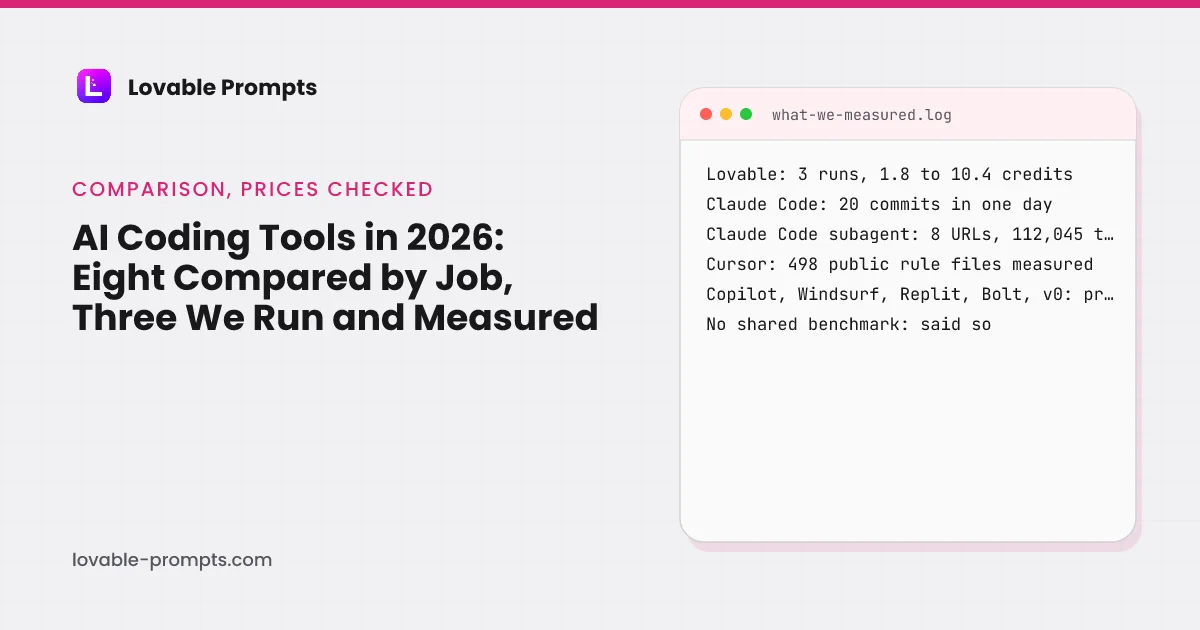
Three of the eight, because those are the three this site is built and maintained with. Everything here is from our own logs; the rest of the roundup is prices and meters.
| Measured | Where the detail lives | |
|---|---|---|
| Lovable | Three library prompts run in a personal workspace: 1.8, 9.5, 10.4 credits, credits page read before and after, screenshots; a built-in SEO review at 1.1 credits | Prompt examples |
| Claude Code | One working day on this repository: 20 commits, 197 files, 8,084 lines added, 1,423 removed, counted from git; one subagent run: 8 URLs checked in 31 seconds and 112,045 tokens | Cursor vs Claude Code |
| Cursor | 498 public rule files measured against Cursor's own guidance; three rule files written for a Lovable export; no timed task run | Cursor rules |
| Bolt, v0, Copilot, Devin, Replit | Prices and metering from the vendor pages only; nothing about output quality | Lovable alternatives |
Builders: prose in, a deployed app out
Lovable
- Pricing
- Free tier with daily build credits; paid plans priced in credits (read on the credits page), read on 26 September 2026. Source
- What gets metered
- Credits per message, build and run credits separate
- What we measured
- Three runs: 1.8, 9.5 and 10.4 credits; two clarifying-question rounds; one SEO review at 1.1 credits
Bolt.new
- Pricing
- Free, Pro $25/mo, Teams $30/mo per member, read on 26 September 2026. Source
- What gets metered
- Tokens; 1M/month free with a 300K daily cap, 10M/month on Pro
- What we measured
- Not run; prices and metering only
v0
- Pricing
- Free with $5 credits, Plus $30/user/mo, Business $100/user/mo, read on 26 September 2026. Source
- What gets metered
- Dollar credits at per-model rates; seven messages a day on Free; credits expire after 65 days
- What we measured
- Not run; prices and metering only
Editors with an agent inside
Cursor
- Pricing
- Hobby free, Pro $20/mo, Pro Plus $60/mo, Ultra $200/mo, Teams $40/user/mo (Premium $120), read on 26 September 2026. Source
- What gets metered
- Included model usage per plan, then on-demand at API rates; per-plan allowances no longer printed
- What we measured
- 498 public rule files measured; three rule files written for a Lovable export; no timed task run
GitHub Copilot
- Pricing
- Free, Pro $10/mo, Pro+ $39/mo, Max $100/mo, Business $19/seat/mo, Enterprise $39/seat/mo, read on 26 September 2026. Source
- What gets metered
- AI credits: 2,000 completions a month on Free; 1,000 base credits on Pro, 3,900 on Pro+, 10,000 on Max
- What we measured
- Not run; prices and metering only
Windsurf (now under Devin)
- Pricing
- windsurf.com/pricing redirects to devin.ai/pricing: Free $0, Pro $20/mo, Max $200/mo, Team $80 base + $40 per seat, read on 26 September 2026. Source
- What gets metered
- Quotas that refresh daily and weekly; overage at API pricing on paid plans
- What we measured
- Not run; the page no longer names Windsurf
Agents that run outside an editor
Claude Code
- Pricing
- Included from Claude Pro ($20/mo, $17 annual) and Max (from $100/mo); Team $20 or $100 per seat annual; API by token, read on 26 September 2026. Source
- What gets metered
- Plan usage in five-hour and weekly windows, or API tokens; Anthropic's enterprise average about $13 per developer per active day
- What we measured
- One day on this repository: 20 commits, 197 files, +8,084 / -1,423 lines; one subagent run at 112,045 tokens
Replit
- Pricing
- Core $20/mo ($18 annual), Pro $100/mo ($90 annual); no free plan listed, read on 26 September 2026. Source
- What gets metered
- Effort-based dollars per agent checkpoint, from about $0.06 upward, cost shown after the checkpoint
- What we measured
- Not run; prices, metering and Replit's own pricing posts only
How should you choose?
By job, then by meter, then by a run on your own task. A builder if you will not open the code; the Lovable alternatives page compares six with the same method. An editor if you want to watch; the rule files are what to write first. A terminal agent if you want to hand over or schedule; the commands and subagents guides show what that looks like in a workspace that runs on it. Anthropic's cost page is the one place a vendor publishes an average, about $13 per developer per active day for enterprise API use; use it as the scale, not the estimate.
Then run one representative task on the free tier of the two finalists and read the meter. That number beats every figure on this page, including ours.
What we deliberately did not publish
- A shared benchmark or a ranking. Same task, same repository, paid seats on all eight, token readouts from each: until it exists this page compares jobs, prices and meters, and one side's own runs.
- SWE-bench or other benchmark scores quoted by the ranking pages. They measure models on a fixed task set, not these products on your repository.
- Codex, Gemini CLI, Amazon Q, Tabnine, Cody and the rest of the twenty-tool lists. We did not read their pricing pages today, so they are absent rather than guessed.
- Windsurf as a product. Its pricing URL redirected to Devin's on 26 September 2026; the card says that and nothing more.
Sources
All checked on 26 September 2026. Prices and adoption figures are in src/data/aiCodingTools.ts.
- JetBrains research blog: AI Coding Agents: Adoption Trends (August 2026)
- Claude Code docs: Manage costs effectively
- Lovable: pricing page
- Bolt.new: pricing page
- v0: pricing page
- Cursor: pricing page
- GitHub Copilot: pricing page
- Windsurf (now under Devin): pricing page
- Claude Code: pricing page
- Replit: pricing page
Frequently asked
What is the best AI coding tool in 2026?↓
Which AI coding tools are free?↓
How much do AI coding tools cost per month?↓
Did you test all eight tools?↓
Is Windsurf still available?↓
Which tool should a Lovable builder add?↓
Related reading
- Lovable alternatives compared
Six builders, same method, prices checked.
- Cursor vs Claude Code
Editor or agent, priced and measured.
- Replit alternatives by job
Builder, IDE or pipeline, six tools.
- Cursor rules
498 public rule files measured, three to copy.
- Claude Code commands and skills
The 25 skills one workspace runs.
- three prompts and what they built
The Lovable runs behind the credit figures.
- how Lovable credits work
The builder's meter, explained.
- coding prompts for ChatGPT, Claude and Copilot
Ten prompts that work in any of them.
- idea to app
The path from prompt to first users, measured.
- vibe coding tips
What building with these tools cost us, from git.
- Lovable pricing
The plans and ladder the tools table could not print.
- Base44 alternatives
The builder that is not on this list, and its rivals.
Written by

Marco Kohns
Founder of ProtoBites - Venture Growth Studio
Growth PM at a Silicon Valley scale-up (a16z and General Catalyst backed), ex-Techstars where he consulted 13 early-stage startups, Reforge-trained. Every prompt on this site comes out of shipping ProtoBites' own portfolio products.