
How Lovable Credits Work (And How to Burn Fewer)
Credits are Lovable's actual cost model, and the part most builders misjudge. Not because the rules are complicated, but because three different things spend from the same balance and the rollover rule appears to contradict the expiry rule. Here is what Lovable's own documentation says, and where prompt quality changes the bill.
Updated
Three things spend from one balance
The most common budgeting mistake is treating credits as a prompting allowance. Lovable's documentation is explicit that credits cover three types of usage, only one of which is you typing:
| What it covers | |
|---|---|
| Build usage | Sending messages in Lovable to plan, generate, edit or update your app. |
| Cloud usage | Hosting your app and running its built-in backend, including database, network, storage, edge functions and realtime usage. |
| AI gateway usage | AI features your deployed app uses, such as calls your app makes to AI models. |
The practical consequence: an app you stopped building can still spend credits, because hosting and any AI features it offers users draw from the same balance. If you ship an AI wrapper to actual users, the gateway line is the one that scales with them, not with you.
Plan mode is flat, Build mode is not
Lovable separates thinking from doing, and prices them differently. Plan mode "never modifies your code, and every message deducts 1 credit." Build mode "pricing is usage-based," and Lovable says small focused edits usually cost less than larger generations, multi-step changes, or requests that require more codebase exploration.
That last clause is the one worth internalising: cost scales with how much of your codebase Lovable has to read to satisfy the request, not only with how much it writes. A vague instruction against a large project is expensive twice over, because it explores more and then produces something you have to correct.
Rollover and expiry are both true
These two statements from Lovable's own material look contradictory and are not:
- "All unused monthly plan credits automatically roll over at the end of each billing cycle, as long as your subscription remains active."
- "Monthly plan credits expire 2 months after issue on monthly plans."
Read together: rollover is genuine but bounded. A credit issued in month one survives into month two and is gone in month three. So a balance that looks like it is accumulating has a rolling two-month shelf life, and a month where you build nothing is not banked indefinitely.
The other expiry rules, from Lovable's pricing page: annual plan credits expire one month after the annual period ends, and top-up credits last twelve months from purchase. Free daily grants are the strictest of all, covered below.
Consumption order works in your favour and needs no management: Lovable "always uses usage-specific grants before general credits," then spends "the general credits closest to expiry first."
The free tier is a daily allowance, not a pool
Lovable's documentation states that free workspaces receive 5 daily build credits, up to 30 per calendar month, and that unused usage-specific grants do not roll over. Two things follow.
First, the free tier rewards showing up rather than saving up: an unused day is simply lost. Second, the monthly ceiling means a burst of free building is not possible even if you wait, because the daily grant caps you regardless.
This is the tier where prompt quality matters most, because five build messages is roughly one feature if you get it right and roughly nothing if you do not.
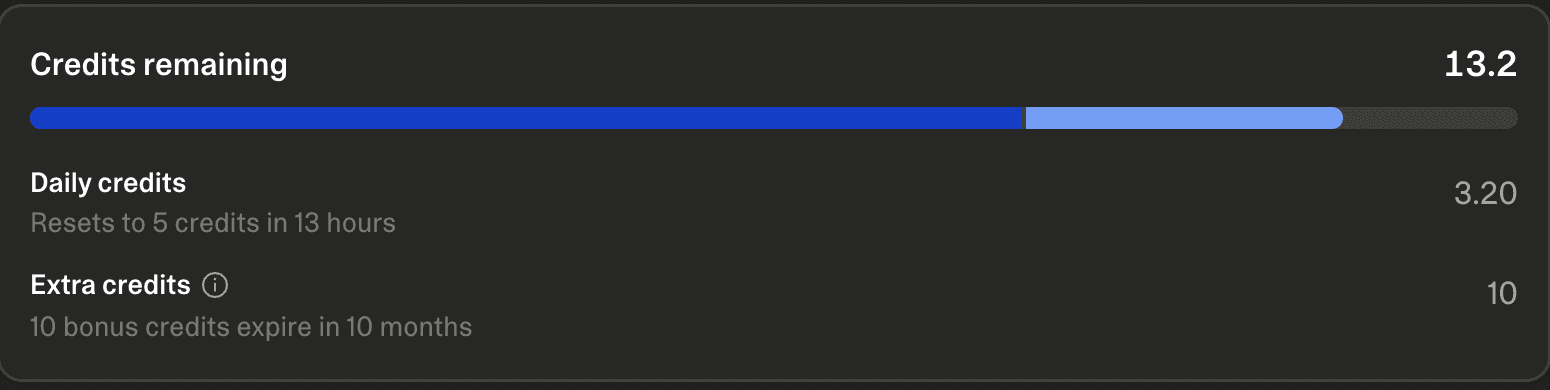
The measured number behind that caption: running one structured library prompt end to end, including Lovable provisioning its backend, cost 1.8 credits in a single round. An unstructured build that needs two correction rounds spends the whole day's grant on the same feature.
How to burn fewer credits
This is the part Lovable's documentation does not cover, and where the cost model and prompt structure meet. Build mode charges partly for exploration, so anything that reduces exploration or reduces correction rounds reduces spend.
Plan in Plan mode, build in Build mode
Plan mode is a flat one credit and cannot touch your code. Working out the approach there and then issuing one specific Build instruction is usually cheaper than three exploratory Build messages, and it is strictly safer.
Number your features
An unordered feature list makes Lovable spread effort evenly and build the wrong thing first. Explicit priority means the expensive generation goes on the feature that matters, and you are not paying to redo it.
Specify the states up front
Empty, loading and error states are the most common omission and the most common second round of prompting. Asking once costs less than asking again per screen.
State the build order
Lovable will happily generate an interface it cannot wire to data. Naming the order stops the generation you throw away.
Scope the request to a surface
Cost scales with how much codebase gets read. A request naming the screen or component is cheaper on a large project than one that makes Lovable go looking.
Do not re-prompt a near-miss from scratch
Correcting the specific thing that is wrong is a small focused edit. Restating the whole feature is a large generation, and Lovable prices those differently.
Every prompt in the prompt library is written to that shape already: numbered priority, explicit states, a build order and constraints that survive later edits. That is a credit-efficiency argument as much as a quality one. If your idea does not match an existing prompt, the generator produces the same structure for it, and how to write prompts for Lovable covers writing them yourself.
A note on prices
This page deliberately quotes no prices. Lovable's plans and credit allowances change, and a stale number is worse than no number. Check Lovable's pricing page for current figures. The mechanics on this page are from Lovable's credits and usage documentation and its pricing page, both read on 29 July 2026. Where Lovable's own wording differs between the two, for example "Default Mode" on the pricing page against "Build mode" in the docs, this page follows the documentation.
Frequently asked
Do Lovable credits roll over or expire?↓
What actually consumes a credit?↓
Does a failed generation cost credits?↓
How much does one message cost?↓
Which credits get spent first?↓
What happens to credits if I cancel?↓
Written by

Marco Kohns
Founder of ProtoBites - Venture Growth Studio
Growth PM at a Silicon Valley scale-up (a16z and General Catalyst backed), ex-Techstars where he consulted 13 early-stage startups, Reforge-trained. Every prompt on this site comes out of shipping ProtoBites' own portfolio products.