
Cursor vs Claude Code: Editor or Agent, Priced and Measured on One Day's Work
Cursor is an editor with an agent in it. Claude Code is an agent you can put in an editor, a terminal, a desktop app, a browser or a cron job. That sentence settles most of the choice, and the rest of this page is the evidence for it: both vendors' own definitions and prices read on the same day, the only published cost averages, one working day of Claude Code on this site's repository counted from git, and a clear line around what we did not measure.
Updated
What is the difference between Cursor and Claude Code?
Take the definitions from the vendors. Cursor's Agent documentation: “Agent is Cursor's assistant that can complete complex coding tasks independently, run terminal commands, and edit code.” Claude Code's overview: “Claude Code is an agentic coding tool that reads your codebase, edits files, runs commands, and integrates with your development tools. Available in your terminal, IDE, desktop app, and browser.” The verbs are the same. The noun before them is not: Cursor is the editor, and Claude Code is the agent, which is why the same overview page carries an “Install for Cursor” link for its extension.
| Cursor | Claude Code | |
|---|---|---|
| What it is | A VS Code-based editor with Agent, tab completions and Bugbot | An agent that runs in the terminal, VS Code, Cursor, JetBrains, a desktop app, the web and Slack |
| Repository instructions | .cursor/rules/*.mdc with globs, description or always-on; AGENTS.md as a “simple alternative” | CLAUDE.md plus .claude/rules/ with path scoping; reads AGENTS.md when no CLAUDE.md exists |
| Undo | Checkpoints: “Agent automatically creates them before making significant changes” | /rewind and double Escape to a conversation and code checkpoint |
| Delegation | Cloud Agents on paid plans | Subagents with their own context, model and tools; agent teams; background sessions |
| Automation | Cursor CLI with “print mode for non-interactive scenarios like scripts, CI pipelines, or automation” | claude -p for pipes and CI, GitHub Actions, scheduled routines in the cloud, /loop in a session |
| Extensibility | Rules, MCP | Skills, hooks, MCP, plugins, the Agent SDK |
| Models | Cursor's own plus third-party models including Claude | Claude models, or third-party providers on the CLI, VS Code and JetBrains |
Our own guides cover the two instruction systems in detail: Cursor rules with three files for a Lovable export, and the Claude Code side split across commands and skills and subagents.
How much do Cursor and Claude Code cost?
Prices as printed on 26 September 2026. Cursor's pricing docs: Hobby free, Pro $20/mo, Pro Plus $60/mo, Ultra $200/mo, Teams Standard $40/user/mo, Teams Premium $120/user/mo. Past the included usage you “continue at the same API rates with pay-as-you-go billing”, and the page no longer prints per-plan dollar allowances, so none are stated here. Claude's pricing page: Pro at $20 a month, or $17 with an annual subscription billed up front; Max from $100 a month in 5x and 20x usage tiers; Team seats at $20 standard or $100 premium per month billed annually ($25 and $125 monthly); Enterprise at a seat price plus usage at API rates. Claude Code is included from Pro up and not on Free.
| Category | USD per month |
|---|---|
| Cursor Pro | 20 |
| Claude Pro (monthly) | 20 |
| Cursor Pro Plus | 60 |
| Claude Max (from) | 100 |
| Cursor Ultra | 200 |
Cursor pricing docs and claude.com/pricing, read 26 September 2026. Claude Pro is $17 on an annual plan; Max is listed as from $100 for both the 5x and 20x tiers.
The number nobody else on this query quotes is Anthropic's own. Its cost management page says: “Across enterprise deployments, the average cost is around $13 per developer per active day and $150-250 per developer per month, with costs remaining below $30 per active day for 90% of users.” That is API billing, not a subscription, and the same page lists what drives it: long sessions never cleared, Opus left as the default, agent teams at roughly 7x a standard session. Cursor publishes no equivalent average.
One documented failure on each side, because pricing is where both have stumbled: The June 2025 Pro repricing replaced a request quota with a dollar allowance, and users hit limits within a few prompts on the stronger models. Cursor's CEO apologised that communication was not clear enough and offered refunds. TechCrunch, 7 July 2025. On Claude Code's side the cost page's own list of why usage climbs in a long session is the honest version of the same complaint, and the fix is procedural: clear between tasks, match the model to the job.
What does one day of Claude Code produce?
This is the figure we can stand behind, because it is our repository and our git log. On 26 September 2026 every commit to the lovable-prompts.com (Next.js) codebase carried a Claude Code co-author line. Counted with git log --since --shortstat:
| Category | count |
|---|---|
| Commits | 20 |
| Files changed | 197 |
| Lines added | 8084 |
| Lines removed | 1423 |
Counted from git on the day; every commit co-authored by Claude Code in a terminal session, reviewed and pushed by a person. Data in src/data/claudeCodeDay.ts.
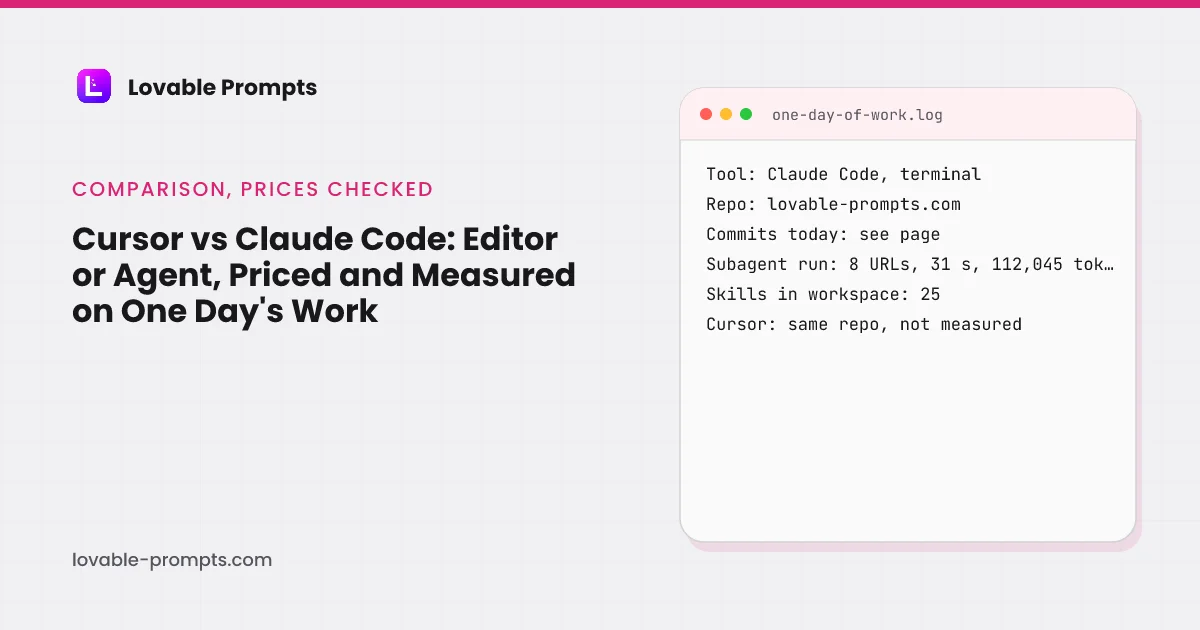
Behind those commits: 6 guides of 2,400 to 3,600 words each with charts and sourced citations, a sitewide internal-link graph with its own build gate, two data-collection scripts, and 2 subagent definitions checked into the repository, alongside 25 custom skills the workspace already ran. One of those subagents has a measured run: 8 cited URLs checked in 31 seconds and 112,045 tokens, finding one citation that had moved. The subagents guide has the file and the numbers.
What this does not show is Cursor doing the same day's work. We use Cursor on other repositories and have no comparable count, so the section ends here rather than with a ratio.
What does each do that the other does not?
| Only in Cursor's docs | Only in Claude Code's docs | |
|---|---|---|
| While you type | Unlimited tab completions on Pro, Pro Plus and Ultra | Nothing; it is not an editor |
| Review | Bugbot on paid plans | GitHub Code Review on every PR; /code-review in a session |
| Delegating work | Cloud Agents | Subagents defined as files with their own tools, model and memory; dynamic workflows |
| Unattended runs | CLI print mode for scripts and CI | Routines in the cloud, desktop scheduled tasks, /loop, Slack, Telegram and Discord channels |
| Guardrails | Rules, enforced Team Rules | Hooks that run shell commands before and after actions, permission modes, managed settings |
| Where it runs | The editor, plus the CLI and the web for cloud agents | Terminal, VS Code, Cursor, JetBrains, desktop, web, mobile app, Slack |
The pattern in that table is not that one tool wins. Cursor's exclusives are about the minute you are typing; Claude Code's are about the hours you are not. That is also the practical answer to using both: the Claude Code memory documentation says it reads AGENTS.md “only when you have no CLAUDE.md in your working directory or above it”, and Cursor's rules page calls AGENTS.md a “simple alternative to .cursor/rules”, so one file can instruct both, with glob-scoped rules and hooks kept on their own sides.
Which one for a Lovable builder who just exported?
Cursor if you have never edited code and want to see every change before it applies; checkpoints and inline diffs are the safety rail, and our three rule files encode the Lovable sync rules so the agent never rewrites the synced branch. Claude Code if the work is repetitive or should happen while you are elsewhere: this site's first three roadmap updates ran in a Claude Code cloud routine, and the Lovable vs Cursor page covers what the export itself changes. If you stay on Lovable, neither is required; the coding prompts page routes each prompt to the tool where it belongs.
What we deliberately did not publish
- The “5.5x fewer tokens” figure that the top-ranking pages repeat from one third-party test. We did not reproduce it and a single task on a single day is not a benchmark.
- Per-plan usage allowances for Cursor, which its pricing page no longer prints, and an exact Max 20x price, which claude.com lists only as “from $100” alongside the 5x tier.
- A same-task comparison. It needs the same repository, the same prompt, the same model on both sides and a token readout from each; until we run it, this page compares documentation, prices and one side's output.
Sources
All checked on 26 September 2026. Cursor facts shared with the other comparison pages live in src/data/comparisons.ts; the day count is in src/data/claudeCodeDay.ts.
Frequently asked
Is Claude Code better than Cursor?↓
Which is cheaper, Cursor or Claude Code?↓
Can you use Claude Code inside Cursor?↓
Did you run the same task in both tools?↓
Which should a Lovable builder pick after exporting?↓
What do the two tools share?↓
Related reading
- Cursor rules
Three .mdc files for a Lovable export, 498 public rules measured.
- Claude Code commands and skills
The 25 skills this workspace runs.
- Claude Code subagents
The measured run behind the number on this page.
- Lovable vs Cursor
What exporting to an editor changes.
- coding prompts for ChatGPT, Claude and Copilot
Where each prompt belongs, per tool.
- Lovable alternatives compared
Cursor as one of six, priced.
- Replit alternatives
Cursor as the IDE route out of Replit.
- how Lovable credits work
The builder's meter, for contrast.
- the prompt library
Prompts that run in either tool.
- the CLAUDE.md file
The instruction file on the Claude Code side.
- Claude Code prompts
Ten briefs for the agent side.
- Cursor prompts
Ten briefs for the editor side.
- cursorrules examples
Six rule files, one per framework.
- AI coding tools in 2026
The wider field, sorted by job.
Written by

Marco Kohns
Founder of ProtoBites - Venture Growth Studio
Growth PM at a Silicon Valley scale-up (a16z and General Catalyst backed), ex-Techstars where he consulted 13 early-stage startups, Reforge-trained. Every prompt on this site comes out of shipping ProtoBites' own portfolio products.