
How to Build an MVP: One SaaS From Prompt to Landing Page in a Day, Every Credit Counted
Every guide for this question is an eight-step list and a price range. This one is a single build: a multi-tenant SaaS called Cadence, started at 12:26 on one day with a library prompt, reviewed for SEO, scanned for security, made installable on a phone and given a landing page by 19:28, with the credits for each step read from the billing page and the screenshots on the page that covers it. It ends where honest MVP stories end: with a working product and no users yet, and the step that comes next.
Updated
What is an MVP for, in the words of the person who named it?
Eric Ries, 3 August 2009: “the minimum viable product is that version of a new product which allows a team to collect the maximum amount of validated learning about customers with the least effort.” And the sentence most guides forget: “MVP, despite the name, is not about creating minimal products.” The build below is judged by that standard. Not whether it is small, but whether it can teach something about customers for the least effort, and effort here is counted in credits.
| Category | % |
|---|---|
| Ran out of capital | 70 |
| Poor product-market fit | 43 |
| Bad timing | 29 |
| Unsustainable unit economics | 19 |
CB Insights, read 26 September 2026: 431 companies analysed, 385 with identifiable reasons; companies cite more than one reason, so the bars do not sum to 100.
Product-market fit and timing are learning failures: the company built before it knew. The MVP is the instrument for knowing earlier, and the cheaper the instrument, the earlier you can afford to use it.
What was built, in what order, and what did each step cost?
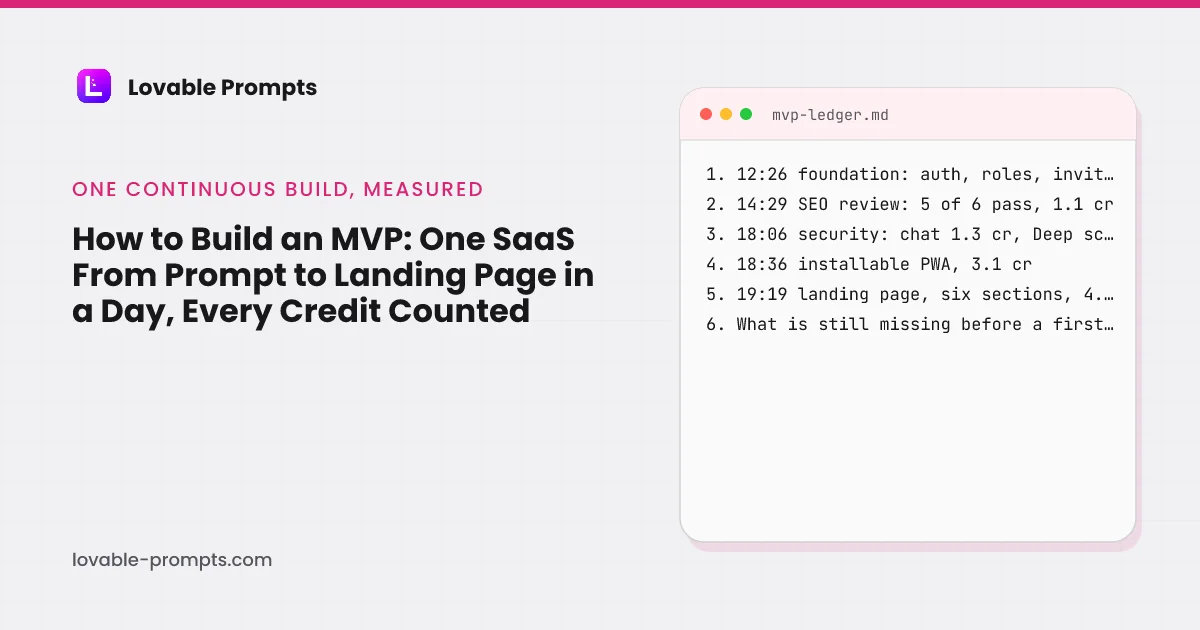
One project in Marco's personal Lovable workspace, on 26 September 2026. Each row is a prompt sent to the builder, the credits it cost as read from the billing page, and what came back. Each links to the page that shows the run.
- Foundation: 12:26, 10.4 cr
- SEO review: 14:29, 1.1 cr
- Security: 18:06, 1.3 cr
- Installable: 18:36, 3.1 cr
- Landing page: 19:19, 4.5 cr
Times from the Lovable chat; credits from the billing page.
| Prompt | Credits | What came back | |
|---|---|---|---|
| 12:26 Foundation | SaaS MVP with User Auth, from the library See the run | 10.4 | Asked 4 questions, enabled Cloud, self-tested sign-up and invites, roles checked in the database |
| 14:29 SEO review | Run an SEO and AI search review of this app and show me the findings. Do not change any code yet. See the run | 1.1 | 5 of 6 checks passing; the one failure was the sitemap, deferred until publish |
| 18:06 Security | Run a deep security scan of this app and list every finding by severity. Do not change any code. See the run | 1.3 | The chat ran its own checks (clean) and said the Deep scan must start from the Security tab; run there, free, 3 minutes, no findings; the dependency panel listed 2 known issues on one package |
| 18:36 Installable | Make this app installable on a phone as a Progressive Web App ... Do not change any feature, table or policy. See the run | 3.1 | Manifest, icons, service worker gated to the published app, Add to Home Screen button; verified in the preview |
| 19:19 Landing page | The six-section SaaS landing page prompt, in a separate project See the run | 4.5 | Five pre-build questions, six minutes to a preview; server-rendered, FAQ schema, one CTA type; 394 words |
| Category | credits |
|---|---|
| Foundation | 10.4 (12:26) |
| SEO review | 1.1 (14:29) |
| Security | 1.3 (18:06) |
| Installable | 3.1 (18:36) |
| Landing page | 4.5 (19:19) |
Read from the billing page after each step on 26 September 2026. The Deep security scan itself was free; the 1.3 is the chat message that asked for it.
The foundation is half the bill and most of the product. Everything after it is the part agency guides put in a later phase: review, harden, install, market. On a builder that asks questions first, each was one message and under five credits.
What does the result look like?
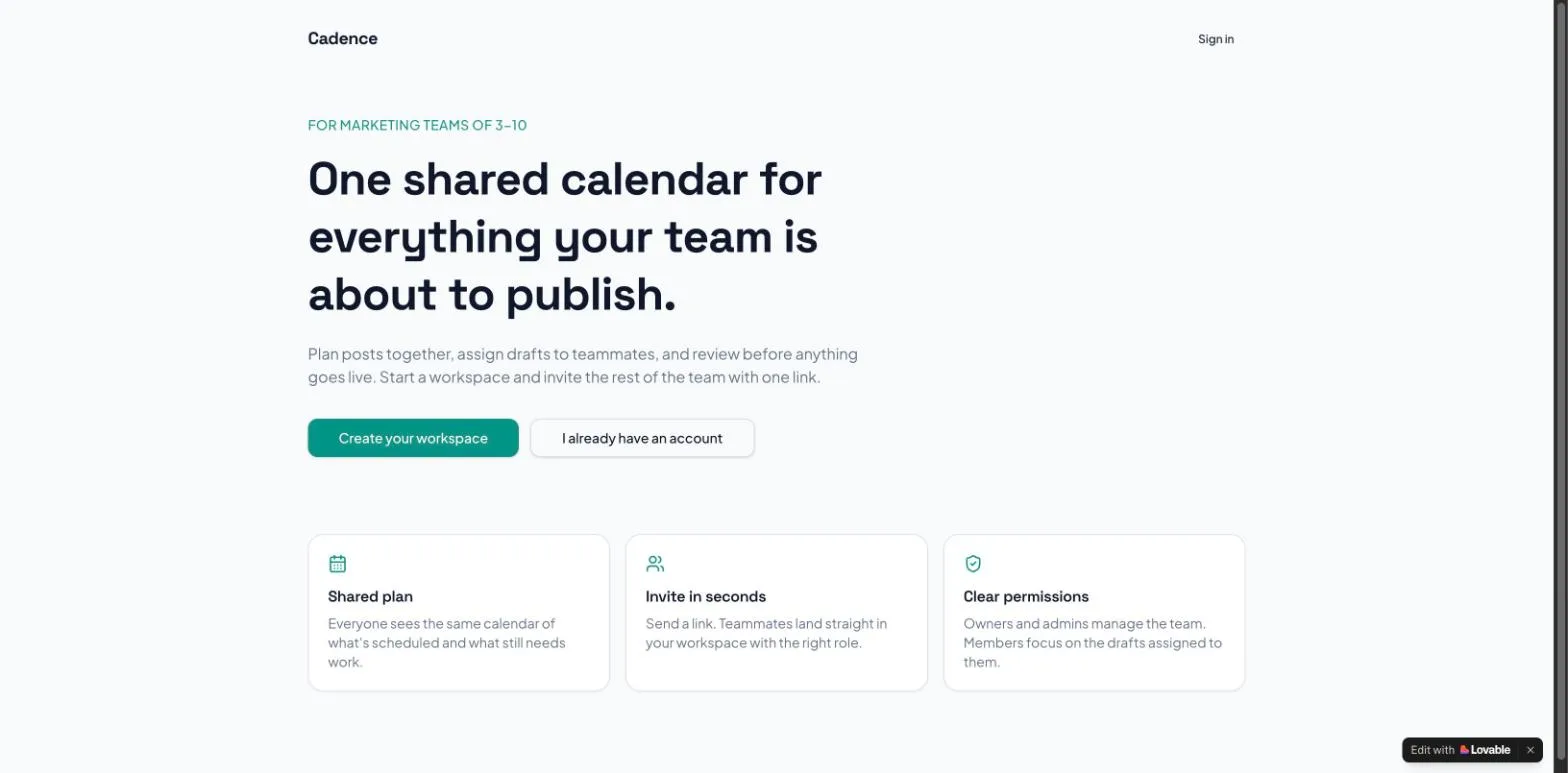
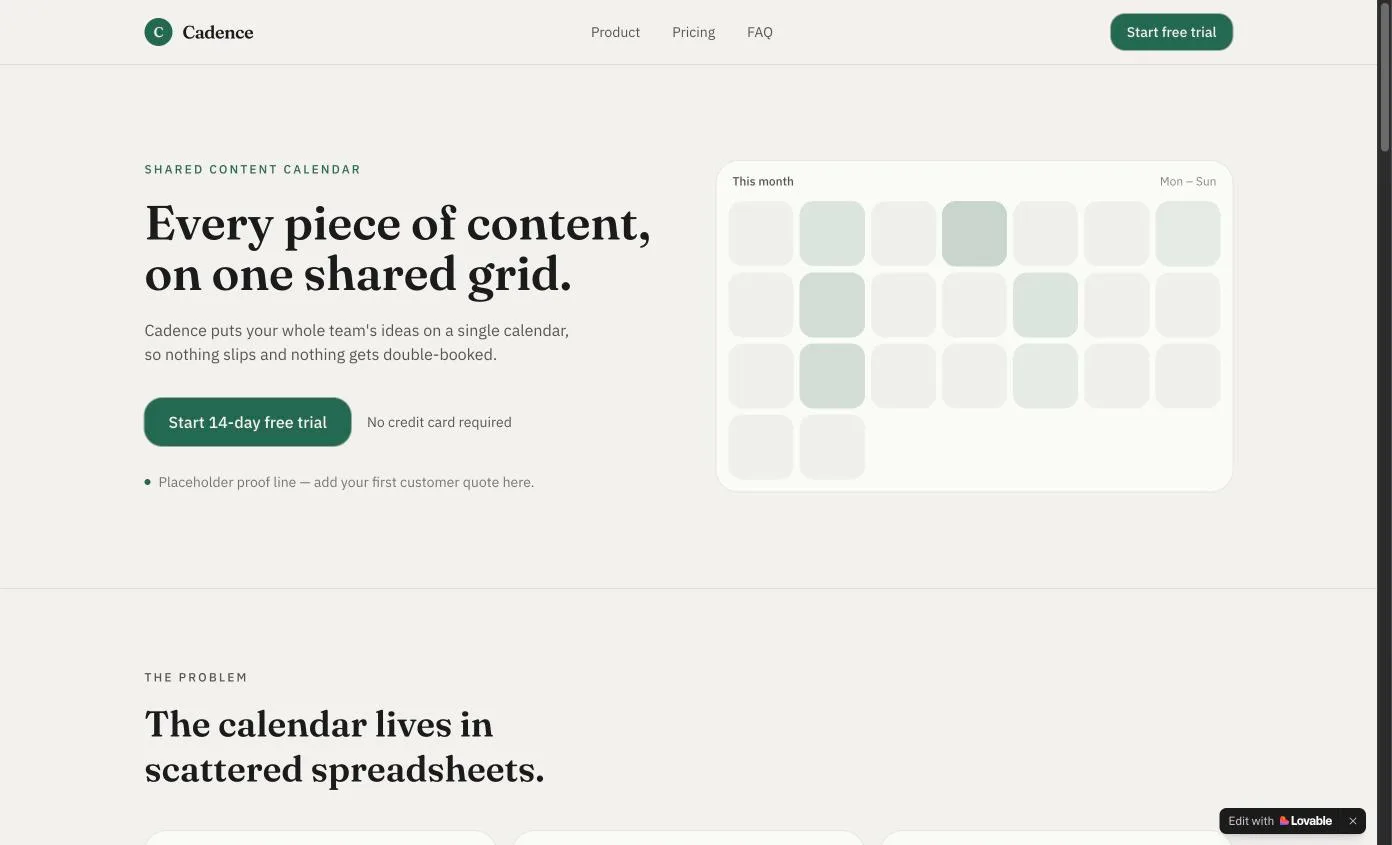
Between the two: the SEO review passed five of six checks and deferred the sitemap until publish; the Deep security scan found nothing at any severity while the dependency panel listed two known issues on one package; the app gained a manifest, icons and an install button. The security and mobile pages have those screenshots.
What is still missing?
A first user, and the things a first user exposes. The product works for the person who built it. Nobody else has signed up, because nobody has been sent to the landing page; it has no traffic and therefore no conversion rate. The proof line on that page still says it is a placeholder, because there is no customer to quote. Payments are not wired; the Lovable and Stripe page is that step when it is earned. None of this is a gap in the build. It is the point at which building stops being the bottleneck.
- Pick one channel: you can work weekly
- Send traffic: to the landing page
- Count sign-ups: against visitors
- Talk to them: the learning
- Then payments: webhook first
The first 100 users and product-channel fit guides, condensed.
The first 100 users page is the long form; product-channel fit is why the channel is chosen before the next feature.
What do the top results for this term leave out?
- Cleveroad, How to Build a Minimum Viable Product in 2026. About 4,500 words, updated 6 January 2026, eight steps, two to six months, $50,000 to $200,000; portfolio projects as evidence; the CTA is the agency.
- UXPin, How to Build an MVP. About 3,400 words, 17 June 2026, eight steps, $5,000 to $150,000 with no sources for the ranges; the CTA is the tool.
- Uptech, How to Build an MVP. About 6,500 words, updated 9 March 2026, eight steps, $5,000 to $100,000 and three to twenty-four months from the agency's own experience; its own products as examples; the CTA is the agency.
None of the three shows a build the reader can repeat with the cost attached, and none ends with the product unused, which is where every MVP actually is on the day it is finished.
What we did not publish
- A conversion rate, a user count or revenue. The product has none yet, and the page says where that changes.
- A timeline in hours. The ledger has clock times because the chat records them; the hours of attention between steps were spent writing the pages that document them, and are not separable.
- A comparison build on another tool. The same day's work on Bolt, v0 or Replit would be the fair test, and it did not happen.
Sources
All read on 26 September 2026. The ledger is composed in src/data/mvpLedger.ts from the run files each step already has.
Frequently asked
What is an MVP?↓
How long does it take to build an MVP?↓
How much does an MVP cost?↓
Why do MVPs fail?↓
What is still missing after this build?↓
Can I follow the same path?↓
Related reading
- three prompts and what they built
The foundation run with its screenshots.
- SaaS landing page prompt
The last step of the ledger.
- Lovable security
The scan step, with the dependency finding.
- Lovable mobile app
The installable step.
- Lovable SEO
The review step.
- first 100 users
Where the story continues.
- product-channel fit
Why the channel comes before the next feature.
- how Lovable credits work
What the ledger's numbers pay for.
- idea to app
The same path, as a method.
- the SaaS starter kit
The foundation as a schema.
- MVP examples
Four MVPs built here with cost, and the famous three sourced.
- build a SaaS
The same build as a SaaS path, kit counted, billing last.
Written by

Marco Kohns
Founder of ProtoBites - Venture Growth Studio
Growth PM at a Silicon Valley scale-up (a16z and General Catalyst backed), ex-Techstars where he consulted 13 early-stage startups, Reforge-trained. Every prompt on this site comes out of shipping ProtoBites' own portfolio products.