
Product Hunt Launch: The Rules From Product Hunt Itself, the Pages to Build First, and Why We Have Not Launched
This page has a gap and says so first: this site has not launched on Product Hunt, so there is no first-party result here. What it has is what can be verified without one. Product Hunt's own launch guide, quoted rather than paraphrased. The third-party figures every checklist recycles, with the source each one came from kept visible. And the four pages a launch sends traffic to, which the prompt library builds in one message each.
Updated
What does Product Hunt itself say a launch needs?
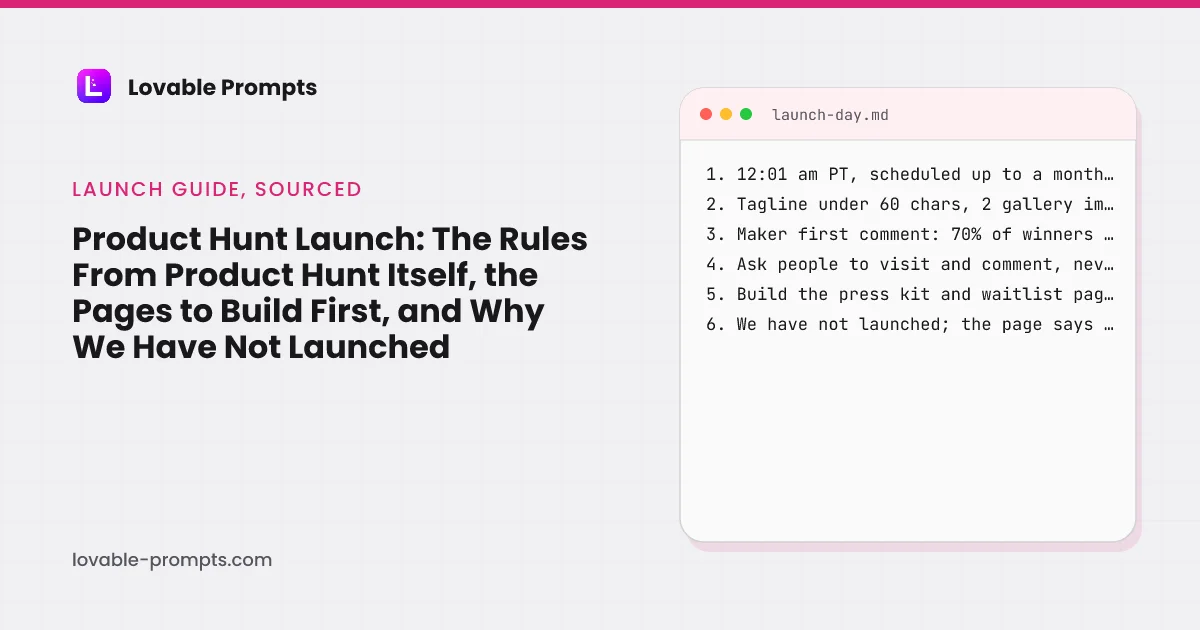
Its preparation guide and launch page, read 26 September 2026, in their own words. Timing: “The homepage runs on a 24-hour cycle based on Pacific Standard Time. Posting at 12:01am PST gives people a full 24 hours to view your product.” And: “You can now schedule your launch up to 1 month in advance so that you can tease it, drive traffic, and collect followers well before your big day.” A counterweight most checklists skip: “products launched on the weekend get 15% more "Visit" button clicks than those on weekdays.”
| In Product Hunt's words | |
|---|---|
| Tagline | Tagline (max 60 characters) |
| Gallery | The gallery will need 2+ images before it is viewable on the post page. The recommended size for images in the gallery is 1270x760. |
| First comment | 70% of products who achieved Product of the Day, Week, or Month had a first comment by the maker. |
| Asking | The only real rule here is that you cannot ask people directly to upvote your product. Instead, ask them to visit and comment. Ask for feedback (NOT upvotes). |
| Tone | being humble and helpful is the best tone. |
| Submitting | Log in, click the "Submit" button in the top right, and then click "New Product." You'll be prompted first to enter in the product's URL and will start the flow to submit your product. |
The rule on asking is the one to design around. If the people you tell cannot be asked to upvote, the launch email, the tweet and the Slack message all say the same thing: here is what we built, come look, tell us what you think. Which is also the only message that produces comments the maker can answer.
What do launches produce, according to people who report their numbers?
Every checklist on the first page cites the same handful of companies. The figures are kept here with two columns the checklists drop: where we read it, and whose number it originally was.
| Where we read it | Whose figure it is | |
|---|---|---|
| 50 to 120 hours of preparation for launches that do well | Lenny's Newsletter guest post, 5 March 2024 | the author's launch agency |
| 1,000 sign-ups on launch day, then about 150 a day | Lenny's Newsletter guest post, 5 March 2024 | Twinr, as cited there |
| 3,900 visitors and 766 new users on day one | Smol Launch guide, updated 23 June 2026 | Tally's own results post, as cited there |
| 1,085 upvotes and 663 sign-ups, from a 25,000-subscriber pre-launch list | Smol Launch guide, updated 23 June 2026 | Dub.co's own blog, as cited there |
The Lenny's Newsletter post also says the author's agency turns away most inquiries as not ready, and that B2B products see far fewer sign-ups than consumer tools. The Smol Launch guide is the most complete checklist on the page and, like this one, reports no launch of its own.
Which pages should exist before the listing does?
A launch is a day of traffic aimed at a URL. What the URL does with it decides whether the day was worth the 50 to 120 hours the agencies quote. Four pages in the library are written for exactly that day, each a single message to Lovable:
- Landing page: one offer, one CTA
- Waitlist: for the not-yet
- Press kit: facts, assets
- Proof page: with permission
- Analytics: source per row
The four Landing Page prompts named below, in the order their build orders assume.
| What it builds | Why it exists on launch day | |
|---|---|---|
| Simple Press Kit Page | Facts, approved quotes, downloadable assets and a contact that answers | A journalist or a newsletter writer on deadline needs the file, not the pitch |
| Waitlist Signup Page | What is coming, what joining gets you, position feedback, a list stored where it cannot be read from the browser | Most launch-day visitors are curious, not ready; the list is the asset that outlives the day |
| Testimonial & Social Proof Page | Verified quotes with permission, results with context | The first comment thread will ask who uses this; the answer needs a URL |
| Basic Analytics for Landing Pages | Visits, sources, device, conversion, drop-off, with UTM stored per row | Without it the launch produces a number nobody can attribute |
All four are in the landing page prompts; the SaaS landing page prompt was run on 26 September 2026 for 4.5 credits, which is the page the listing should point at. The first 100 users page has the argument for treating a launch as one channel among several, not as the plan.
Why has this site not launched?
This site has not launched on Product Hunt. Its September 2026 backlink audit lists no Product Hunt, GitHub, Reddit or Hacker News link among its referring domains, which is the concrete form of the argument below: the launch is a link and a list, or it is nothing.
The honest reason is sequencing, not doubt. The site's growth work this month went into the pages the launch would point at and the links a launch would earn; the Lovable SEO page carries the crawl evidence behind that choice. When the launch happens, this page gets the result, dated, and the lede changes. Until then the page is a set of rules and artifacts, and is labelled as one.
What do the top results for this term leave out?
- Product Hunt's own guides. The rules, first-hand, and the 70% first-comment figure; no sign-up numbers, no pages to build.
- Lenny's Newsletter guest post. About 4,500 words, 5 March 2024, agency figures and Twinr's; templates behind links; its author's firm is the product.
- Smol Launch guide. About 3,300 words, updated 23 June 2026, a seven-step checklist and three company case studies; no first-party launch; promotes its own platform.
What we did not publish
- A launch result of ours. There is none; the roadmap for this page asked for one and the page says why it is absent.
- An upvote or traffic forecast. The third-party figures are ranges from other companies' posts, not a model.
- A hunter recommendation or a launch service. The rules above are enough to launch without either, and we have not tested any.
Sources
All read on 26 September 2026. Quotes and figures in src/data/productHunt.ts.
Frequently asked
When should I launch on Product Hunt?↓
Can I ask people to upvote?↓
What do I need ready before submitting?↓
How many sign-ups does a launch bring?↓
Have you launched on Product Hunt?↓
What should I build with Lovable before launch day?↓
Related reading
- landing page prompts by traffic source
The press kit, waitlist, proof and analytics prompts.
- SaaS landing page prompt
The page the listing points at, run for 4.5 credits.
- first 100 users
A launch as one channel among several.
- product-channel fit
Why a launch is not a plan.
- Lovable SEO
The crawl evidence behind sequencing links first.
- app ideas
Fifty ideas by channel.
- idea to app
Prompt, build, then distribution on day one.
- landing page kit
The leads table a waitlist writes to.
- how to write Lovable prompts
The shape of the four launch-day prompts.
- vibe coding tips from our own mistakes
Count what a day produced, or it produced nothing.
Written by

Marco Kohns
Founder of ProtoBites - Venture Growth Studio
Growth PM at a Silicon Valley scale-up (a16z and General Catalyst backed), ex-Techstars where he consulted 13 early-stage startups, Reforge-trained. Every prompt on this site comes out of shipping ProtoBites' own portfolio products.